
Music Promotion Checklist: Essential Steps for 2026
Music Promotion Checklist: Essential Steps for 2026
In 2026, promoting your music requires a structured plan to break through the crowded music industry. With over 100,000 songs uploaded daily, standing out means leveraging tools like AI, social media, and playlist strategies. Here's how you can make an impact:
- Start Early: Begin 6–8 weeks before release to handle technical, legal, and promotional tasks.
- Optimize Metadata: Ensure track titles, ISRC codes, and genre tags are correct.
- Create an EPK: Include bios, high-quality photos, music links, and press quotes.
- Social Media Setup: Update profiles, use smart links, and create a 30-day content calendar.
- Short-Form Videos: Produce 15–20 TikTok, Instagram Reels, or YouTube Shorts clips.
- Playlist Pitching: Submit tracks to Spotify and independent curators 4–6 weeks in advance.
- Influencer Outreach: Partner with micro-influencers for authentic promotion.
- Paid Ads: Use platforms like TikTok Spark Ads and Spotify Ad Studio to boost visibility.
- Track Metrics: Monitor saves, playlist adds, and engagement to refine your strategy.
Consistency is key post-launch. Keep engaging fans with fresh content, track performance, and continue pitching to playlists. Success in music promotion today requires smart planning and a focus on connecting with the right audience.
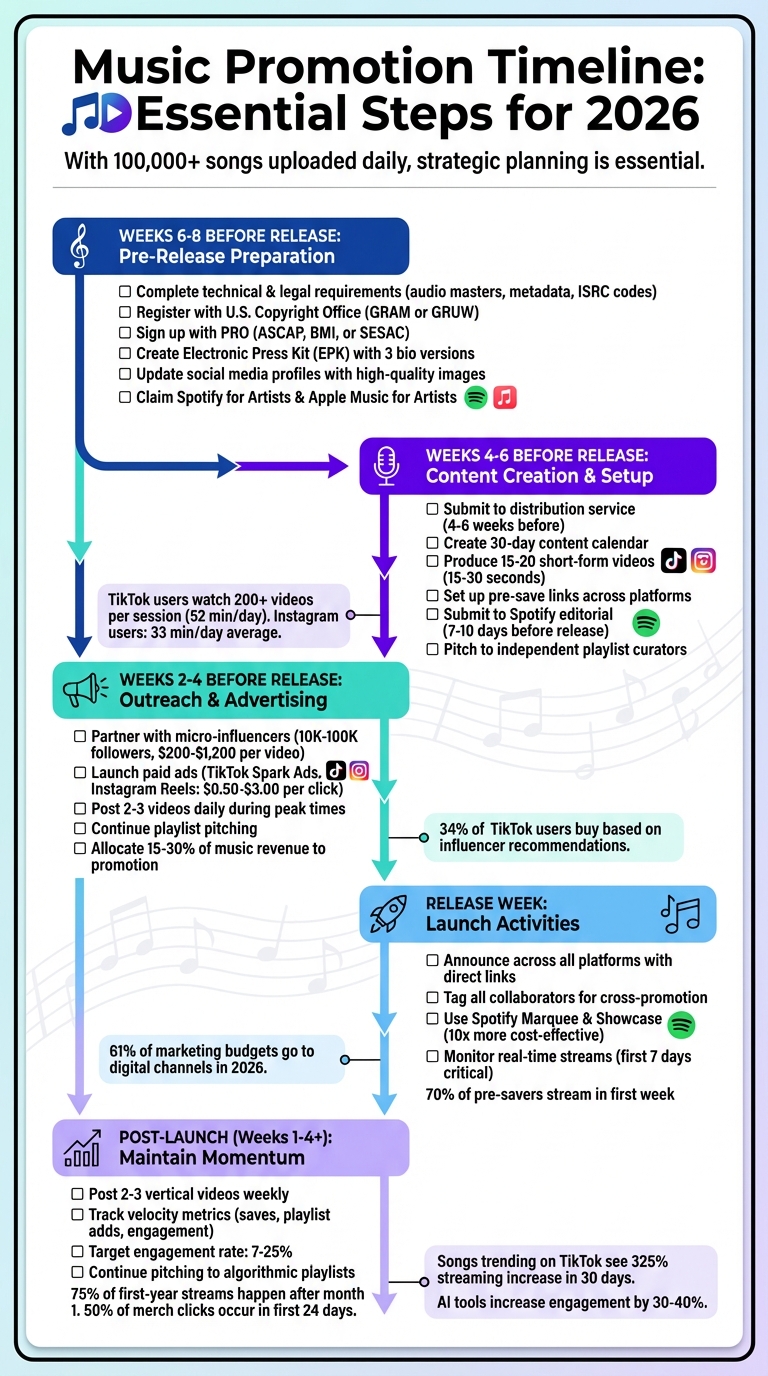
Music Promotion Timeline: 8-Week Pre-Release to Post-Launch Checklist
How This Artist Got 1M Monthly Listeners Overnight (Top Ways to Promote Music in 2026)
sbb-itb-e87b2af
Pre-Release Preparation
Starting your preparations 6–8 weeks before your release date gives you enough time to handle all the technical, legal, and promotional tasks. This lead time ensures everything is in place before your music hits the streaming platforms.
Complete Technical and Legal Requirements
First things first - finalize your audio masters and double-check your metadata. Make sure details like track titles, artist names, genre tags, and ISRC codes are accurate. Even small mistakes can cause big headaches when your music is distributed.
Next, register your work with the U.S. Copyright Office using eCO. Depending on your situation, you can choose between the Group Registration for Works on an Album of Music (GRAM) or the Group Registration of Unpublished Works (GRUW). Both options let you register up to 10 works in a single application.
Don’t forget to sign up with a Performing Rights Organization (PRO) such as ASCAP, BMI, or SESAC. These organizations ensure you get paid performance royalties when your music is played publicly.
Once these technical and legal steps are squared away, you can shift your focus to building a polished digital presence.
Create an Electronic Press Kit (EPK)
Think of your EPK as your digital music resume. It’s the go-to resource for journalists, playlist curators, and booking agents deciding whether to feature your work. Hosting your EPK on your website - not a cluttered drive - keeps things professional and drives traffic to your domain.
"Your Electronic Press Kit (EPK) is your digital music resume. It's not a messy Google Drive folder. It's a clean, curated package designed to make a journalist's or booker's job ridiculously easy." - artist.tools
Your EPK should include three versions of your artist bio: a short elevator pitch (1–2 sentences), a medium-length paragraph, and a full-length version. Add high-resolution photos in multiple formats (portrait, landscape, square) to suit different needs. Also, include links to your mastered tracks, official music videos, and any press quotes or accolades you’ve received. Don’t forget to make your contact information easy to find.
With your EPK ready, it’s time to ensure your social media profiles reflect the same level of professionalism.
Set Up Your Social Media Profiles
Start by updating your profile photos and banners across all platforms with high-quality images that match the vibe of your upcoming release. Use a single smart link in your bio to consolidate pre-saves, streaming links, and your website - tools like Show.co or Linktree are great for this.
Pin an introductory video to the top of your profiles so new visitors can immediately get a sense of who you are. Keep your social media handles consistent across platforms to make it easy for fans to find you. These small steps now will make a big difference when you start engaging on platforms like TikTok later.
Also, claim and verify your Spotify for Artists and Apple Music for Artists profiles. This unlocks customization tools and gives you access to valuable analytics. About 5–6 weeks before your release, create a 30-day content calendar. Then, as you approach the 4–5 week mark, shift your primary call-to-action to a pre-save link to build momentum.
Content Creation and Platform Setup
Short-form videos have become the go-to method for music discovery. TikTok users alone watch over 200 videos per session, spending an average of 52 minutes daily on the app. Instagram users, on the other hand, spend about 33 minutes per day scrolling through their feeds. These numbers highlight a massive opportunity - but only if your content is engaging enough to capture attention. To make the most of it, start by refining your social profiles and tailoring standout short-form video content for each platform.
Produce Short-Form Video Content
For each release cycle, aim to create 15–20 short videos spanning the four weeks leading up to your launch and the two weeks that follow. Stick to vertical videos between 15–30 seconds long - this format works best for TikTok, Instagram Reels, and YouTube Shorts.
"Attention spans are short. If you're not grabbing someone's eye, you're not grabbing their ear either." - 8octaves
The first three seconds of your video are crucial. Kick things off with a hook - the catchiest part of your track, like the chorus. Use platform-specific features such as filters, stickers, and transitions. These tools help signal to the algorithm that your content is designed natively for the platform, increasing its chances of being promoted.
Plan for four types of content to keep things fresh: catchy hook clips (15–30 seconds), behind-the-scenes snippets, artist introductions, and stylized visualizers. Interestingly, raw, unpolished footage often resonates better than heavily edited videos, offering a glimpse into your authentic creative process.
Adapt Content for Multiple Platforms
Each platform has its quirks, and understanding them is key. For example, Instagram now favors original content created within its app over reposted videos that carry TikTok watermarks. That means you’ll need to create platform-specific versions instead of recycling the same video across all channels.
You can still repurpose assets like cover art to keep your content fresh without reinventing the wheel. Stick to consistent branding - use the same logos, fonts, and color palette so your followers instantly recognize your posts.
Leverage your strongest platform to promote others. For instance, if you have a loyal Twitter following, direct those fans to your TikTok or YouTube channel to expand your reach.
Use AI Tools for Video Creation
AI tools can simplify and speed up video production, making your content strategy more efficient. For example, SoundRise specializes in creating TikTok-ready videos using a slideshow format that pulls images from sources like Pinterest. These videos can be customized to match your aesthetic, scheduled automatically, and even posted across multiple TikTok accounts.
Other tools like InVideo transform song lyrics or scripts into polished videos with minimal effort, while Predis.ai helps generate captions, hashtags, and branded visuals. These tools analyze your music’s rhythm and mood, syncing visuals to create teasers and lyric videos that align with trending styles. Incorporating these tools into your strategy can increase engagement by 30% to 40%.
"AI tools let you create video content, but monetisation on TikTok still depends on your offer, your call-to-action, your engagement, and whether you meet platform rules." - Tanmay Ratnaparkhe, Co-founder, Predis.ai
AI can also help you post at peak times for maximum visibility. For Instagram, this typically means weekdays between 11:00 AM–1:00 PM and 7:00 PM–9:00 PM EST. TikTok sees the most activity during evening hours. Posting 2–3 times daily during these windows keeps your audience engaged and ensures the algorithm works in your favor.
Playlist Pitching and Influencer Outreach
Once your content is polished and ready, it's time to amplify your reach by tapping into playlists and collaborating with influencers. These steps can connect your music to thousands of potential listeners. With over 2 billion playlists on Spotify alone, curating the right strategy is essential. The trick? Targeting the right curators and influencers with a thoughtful and personalized approach.
Submit to Playlists
To get started, submit your track through your distribution service at least 4–6 weeks before your release date. This gives platforms enough time to process your music and meet their deadlines. For Spotify, use the Spotify for Artists platform to submit your editorial pitch 7–10 days before release. Missing this timeframe could mean your track won’t make it to the Release Radar playlist.
Make sure your metadata is on point - this includes details like genre, subgenre, mood, instrumentation, and culture tags. Accurate metadata helps algorithms position your track where it belongs. Focus on pitching one track per release, ideally a song you haven’t pitched before. Use the 500-character pitch box to highlight off-platform momentum, such as radio plays, upcoming tours, or press mentions.
"A great pitch isn't about begging for a spot. It's about showing a curator why your track is a perfect fit for their specific audience. You're helping them do their job better." – artist.tools
Beyond Spotify's editorial playlists, independent curators are another goldmine. Use reputable playlist submission services to connect with curators in your genre. Be sure to research playlists to confirm they have active listeners (not bots!) and tailor your pitch to explain how your track matches their vibe. Stay away from services that guarantee placements on massive, vague playlists - they often rely on bot farms, which can lead to account bans.
Once your music lands in the right playlists, the next step is leveraging influencers to boost engagement.
Partner with Micro-Influencers
Micro-influencers - those with 10,000 to 100,000 followers - strike a perfect balance between reach and audience connection. They typically charge $200 to $1,200 per video while offering higher trust and niche expertise. Here’s a telling stat: 34% of TikTok users have made purchases based on influencer recommendations.
When evaluating influencers, calculate their engagement rate using this formula:
(Likes + Comments + Shares + Saves) ÷ Total Video Views × 100.
For TikTok, an engagement rate of 6–10% is solid, while 10% or higher is exceptional. Also, ask for a screenshot of their audience analytics to confirm their location aligns with your target market.
When reaching out, skip the generic DMs. Instead, use the business email listed in their bio and reference a specific video you enjoyed. Be upfront about the partnership being paid, and ask for their media kit with rates for specific deliverables (e.g., one TikTok video and two Instagram Stories). Provide them with a smart link to make it easy for their followers to choose their preferred streaming platform.
"People buy from people, not corporations. A genuine endorsement from a credible influencer carries weight." – Hypefy
Let influencers have creative freedom while providing clear goals and talking points to ensure authenticity. Formats like Duets, Stitches, or remixes are excellent for encouraging audience interaction. Make sure influencers disclose paid partnerships using tags like #ad or #sponsored, and have them activate the “Paid partnership” label to stay compliant with advertising guidelines. For compensation, a mix of a base fee plus commission is proving to be the most effective model in 2026. It guarantees payment while motivating influencers to perform their best.
Paid Advertising and Performance Tracking
You've gained momentum with playlists and influencers - now it's time to take things up a notch with paid ads while keeping a close eye on performance. By 2026, 61% of total marketing budgets will go to digital channels, and independent artists typically allocate 15–30% of their total music revenue to promotion. The trick? Aligning your spending with your specific goals.
Plan Your Advertising Budget
Building on the success of playlists and influencer collaborations, paid advertising can help you amplify your reach.
Start by tying your budget to clear objectives. As Sara Vicioso, Paid Media Expert at Workshop Digital, puts it:
"If your budget starts with 'We need more in paid search' instead of 'We need X% revenue growth from new customers,' you're planning backward."
Top-performing teams dedicate 5–15% of their marketing budget to experimenting with AI-driven tools and strategies.
If your budget is tight, focus on promoting organic content that’s already performing well. Platforms like TikTok Spark Ads and Instagram Reels promotions are excellent choices, with ad costs ranging from $0.50 to $3.00 per click. Spotify Ad Studio is another option, allowing you to target fans of similar artists. Micro-influencer partnerships can also be cost-effective, starting as low as $20–$100 per post. Don’t forget to factor in the costs for creating content, like video production, landing pages, and ad visuals.
Prioritize vertical video formats such as Instagram Reels, TikTok Ads, and YouTube Shorts, which deliver 22% higher engagement. Use hyper-targeting to retarget users who’ve already interacted with your content. TikTok, in particular, offers a huge opportunity - songs that gain traction on the platform often see streaming increases of 325% within 30 days.
Track Performance Metrics
The success of your campaigns hinges on tracking the right metrics. Focus on velocity metrics, which measure how quickly your song gains traction, rather than just total streams. Jackson Bull, former Program Director at SiriusXM, emphasizes:
"Velocity metrics, or how quickly it [the song] grew, that KPI [Key Performance Indicator] is so much more important than total streams."
Use Spotify for Artists to monitor key engagement signals like monthly listeners, saves, and playlist adds. These metrics are more influential in 2026 than passive streams, as algorithms increasingly prioritize engagement. On social platforms, track your engagement rate using this formula: (Likes + Comments + Shares + Saves) ÷ Total Video Views × 100. A strong performance falls within an engagement rate of 7–25%. Additionally, monitor Customer Acquisition Cost (CAC) to evaluate efficiency and Return on Ad Spend (ROAS) to guide future strategies.
For TikTok campaigns, weekly retention metrics can help you pinpoint where viewers lose interest in your video ads. Use this data to tweak your hooks for better results in future campaigns. Spotify Ad Studio also provides streaming conversion metrics, showing how many listeners your ads converted into streams. With over 60,000 songs uploaded to Spotify daily, precise tracking isn’t just helpful - it’s essential for standing out.
Release Week and Post-Launch Activities
Now it’s time to put your plan into action. Release day is just the beginning. Did you know that nearly 70% of users who pre-save an album on Spotify stream it during the first week? And on average, 75% of a release's total streams in its first year happen after the first month. These numbers show why staying active after launch day is just as important as the initial release. Your release day efforts should be the kickoff to a much larger, ongoing strategy.
Execute Your Release Day Plan
Start by announcing your release across platforms like Instagram, TikTok, Facebook, Threads, and X. Use high-quality visuals and include direct links to your music. Update your link-in-bio, website, and pinned posts to make it easy for fans to find your new track. Don’t forget to email your mailing list as soon as the release goes live.
Make sure to tag everyone involved in the project - producers, engineers, and featured artists. This can help encourage cross-promotion, expanding your reach. If you’re on Spotify, take advantage of tools like Marquee (full-screen recommendations) and Showcase (Home banners). Marquee has been shown to be 10x more cost-effective at driving Spotify listeners compared to similar social media ads. Even better, combining Showcase with Marquee can lead to a 5x higher increase in new active listeners.
Celebrate milestones like playlist placements or streaming achievements to create social proof. Timing is key here - over 50% of all merch clicks on Spotify happen within the first 24 days of a new release. Use Spotify for Artists to tag your merch and make it more visible to fans.
Maintain Activity After Release
Once your release is live, the work doesn’t stop. Keep the momentum going by preparing 10 vertical videos ahead of time and posting 2–3 each week following the launch. Variety is essential to keeping fans engaged. Share behind-the-scenes clips, lyric videos, acoustic renditions, remixes, or live recordings to give fans fresh ways to connect with your music.
If you haven’t already, switch to a TikTok Artist Account to unlock music-focused features like artist tags and music tabs. Develop 3–5 content themes to rotate through, such as hook-first performances, stories behind the lyrics, mini-tutorials, life on tour, or fan reactions. Use TikTok Spark Ads to amplify organic posts that are already gaining traction instead of creating entirely new ads. You can also run fan contests, encouraging followers to create their own videos using your track. Offer small but meaningful prizes like free merch to keep them motivated.
"The biggest mistake artists make? Giving up on promotion too soon." - Alana Bonilla, CD Baby
Keep an eye on your real-time streams using Spotify for Artists during the first seven days to gauge your immediate impact. Use tools like AI analytics (e.g., Hootsuite) to monitor performance across platforms and double down on what’s working. These analytics can help you fine-tune your promotional efforts as you go. And don’t stop pitching your track to algorithmic playlists like Discover Weekly or Release Radar even after the first week. With over 100,000 new songs uploaded to streaming services every day, consistent post-launch activity is what keeps your music from fading into the background and helps it stand out for the long haul.
Conclusion
Promoting music in 2026 requires thoughtful preparation, consistency, and smart use of tools. Start early to lock in distribution channels, secure playlist spots, and create engaging content. Laying this groundwork is what distinguishes artists who build lasting careers from those who get lost in the flood of over 100,000 songs uploaded daily.
Instead of trying to be everywhere at once, focus on one or two platforms that play to your strengths. Short-form video content on platforms like TikTok, Instagram Reels, and YouTube Shorts continues to dominate music discovery, so aim for authentic, relatable posts over overly polished productions. Engage directly with your fans through polls, Q&As, and personal interactions. Fans who feel connected to you are more likely to become loyal supporters. This targeted approach also sets the stage for refining your strategies with real data.
Track your progress by monitoring key metrics like monthly listeners, email open rates, and social media engagement. Use this data to set SMART goals (Specific, Measurable, Achievable, Relevant, Time-bound), such as "Gain 500 TikTok followers in 60 days", to guide your efforts and improve your approach for future releases.
Take advantage of tools like SoundRise to simplify tasks like video creation and scheduling. These platforms, with AI-powered features and genre-specific options, let you maintain a steady content flow while freeing up time to focus on your music.
Stay adaptable, experiment with different strategies, and adjust based on what the data tells you. In 2026, success isn't just about talent - it's about pairing great music with smart, consistent promotion. By incorporating these steps into your plan, you'll be better equipped to thrive in the competitive music landscape.
FAQs
How can AI tools help me promote my music more effectively in 2026?
AI tools are transforming the way music promotion is done, making it easier to tackle time-consuming tasks and focus on what really matters. Need a TikTok script, press release, newsletter, or artist bio? AI can whip those up in seconds, freeing up hours of your time each week. On top of that, AI-driven analytics dive deep into millions of interactions on platforms like TikTok and Spotify to pinpoint the best hashtags, trends, and posting schedules, ensuring your content connects with the right audience.
But it doesn’t stop there. These tools can also generate custom soundscapes or backing tracks in just minutes, cutting down on production costs while supplying fresh content for your social media or ad campaigns. And with audience segmentation features, you can tailor emails, artist bios, and playlist submissions to specific fan groups, making your outreach feel personal and increasing your chances of standing out. By weaving AI tools into your promotion strategy, you can save time, refine your targeting, and engage your audience with less effort.
What makes an Electronic Press Kit (EPK) effective for music promotion?
An Electronic Press Kit (EPK) serves as a polished digital portfolio, crafted to present your music and brand to industry insiders. To make it effective, include a well-written artist bio that tells your story and showcases your style. Pair this with high-quality press photos that capture your image and personality, and provide clickable links to your music on platforms like Spotify or YouTube. Adding embedded videos of your top performances or live shows can also help highlight your sound and stage presence.
To build trust and credibility, feature press coverage, reviews, awards, or key achievements. Include a schedule of upcoming tour dates or gigs to give a sense of your current activity. Make sure to add your social media profiles, official website, and a direct contact point - whether it’s your manager, booking agent, or PR representative - so interested parties can easily get in touch. Finally, ensure your EPK is organized in a clean, mobile-friendly format with simple navigation to maintain a professional and accessible presentation.
Why is reaching out to influencers important for promoting your music?
Connecting with influencers can be a game-changer for promoting your music. These individuals have built trust with their audiences, and their recommendations carry weight. By teaming up with playlist curators, bloggers, or TikTok creators, you can tap into their credibility to transform casual listeners into dedicated fans while boosting your visibility and reach.
Influencers are also key players in keeping your music in the spotlight on platforms like TikTok and Instagram, where discovery thrives. Partnering with them can help amplify your message, generate buzz, and even spark viral moments. These moments can lead to more streams, increased sales, and opportunities for live performances.
In the fast-paced world of music, reaching out to influencers isn’t just a nice-to-have - it’s a must if you want to grow your audience and stand out in a crowded space.