
Organic vs Paid Music Promotion: A Complete Breakdown
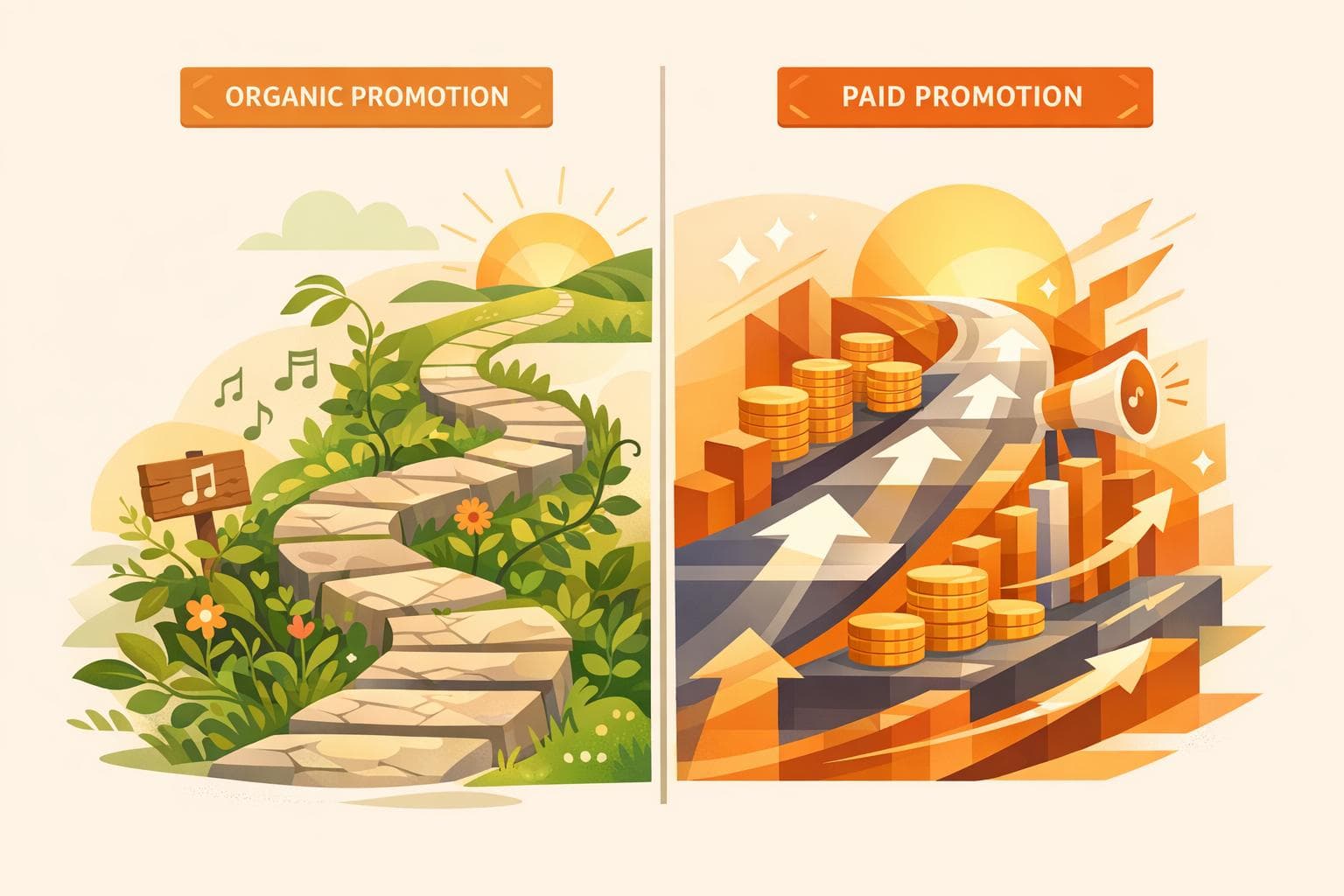
Organic vs Paid Music Promotion: A Complete Breakdown
When it comes to promoting your music, you have two main options: organic promotion and paid promotion. Organic promotion involves building your audience naturally through platforms like TikTok or social media, relying on time and effort rather than money. Paid promotion, on the other hand, uses ads or influencer campaigns to quickly reach listeners but requires a budget.
Here’s the key takeaway:
- Organic Promotion: Slower results but builds long-term, loyal fans. Requires consistent effort and time.
- Paid Promotion: Delivers fast results but needs ongoing funding to maintain momentum. Best for quick visibility or boosting existing content.
Most successful artists use a mix of both, starting with organic methods to test content and then amplifying it with paid campaigns.
Quick Comparison
| Criteria | Organic Promotion | Paid Promotion |
|---|---|---|
| Cost | Free but time-intensive | Requires a budget ($8–$80,000+) |
| Speed | Gradual growth over months/years | Results visible within 24 hours |
| Audience | Loyal, long-term fans | May feel less personal or natural |
| Scalability | Limited by time and effort | Easily scalable with higher budgets |
| Best For | Building a strong fan base | Launching new music quickly |
If you’re just starting out, focus on organic methods. As you grow, combine both strategies for maximum impact.
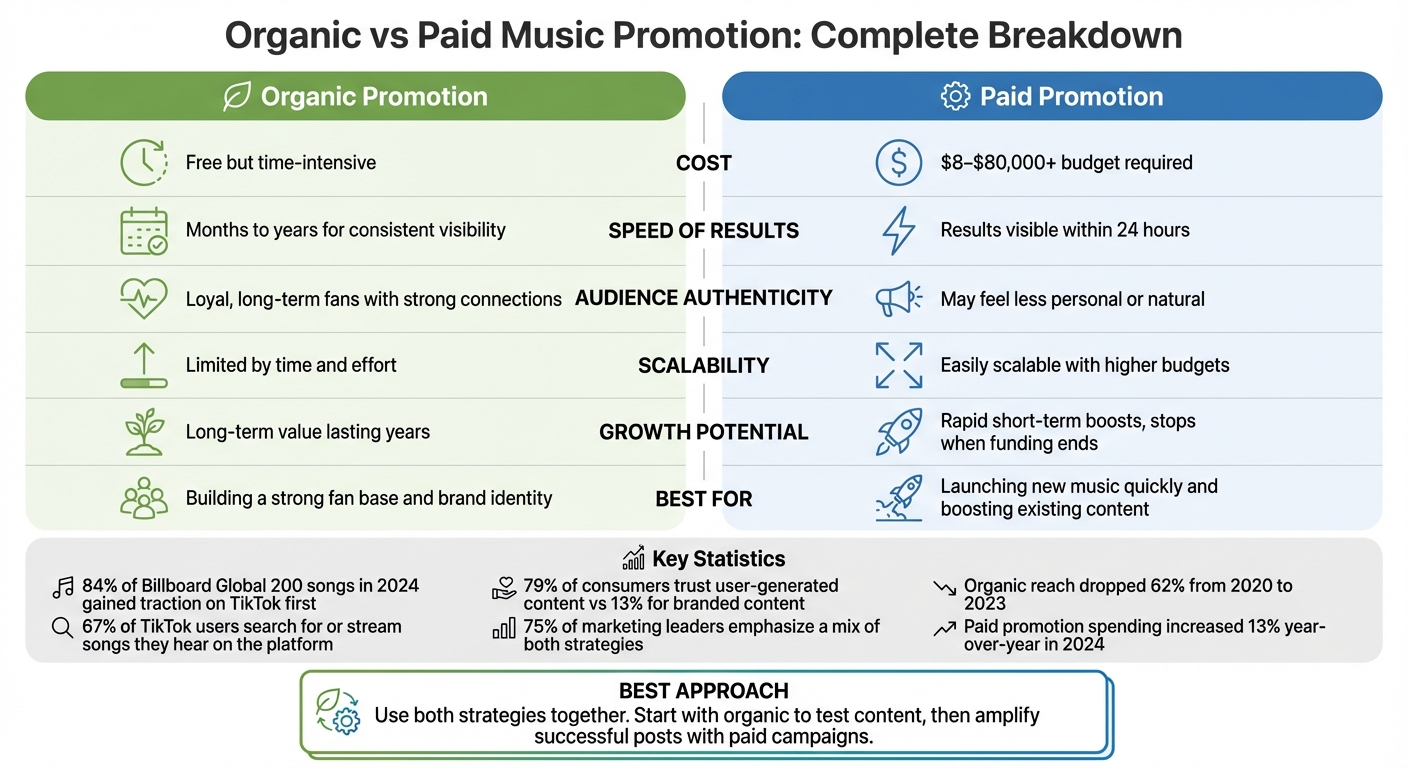
Organic vs Paid Music Promotion Comparison Chart
1. Organic Music Promotion
Cost
When it comes to organic promotion, you're investing time rather than money. Instead of shelling out for ads, your focus shifts to creating engaging TikTok videos, connecting with your fans, and producing content that resonates. The real cost here is the time you dedicate - posting three to four times a week, keeping an eye on trends, and actively engaging with your audience to build meaningful relationships. This time commitment is the foundation of any successful organic strategy.
Speed of Results
Timing is another major consideration. While paid campaigns can deliver quick results - sometimes within just 24 hours - organic strategies take a slower, more gradual path. It can take months, or even years, to achieve consistent visibility. However, the payoff for this sustained effort is long-term growth. For example, one up-and-coming artist saw a massive 3,600% jump in their monthly Spotify listeners - from 2,400 to 93,000 - in just 28 days by riding the momentum of TikTok. With organic promotion, patience is your best ally, as your content continues to attract new listeners long after it’s been posted.
Audience Authenticity
One of the biggest perks of organic promotion is the authenticity of the audience it attracts. Fans who discover your music through TikTok's For You page or through word-of-mouth tend to form a stronger connection to your work. These listeners are more likely to stick around for your future releases. As Loop Fans puts it:
Organic growth creates a loyal, enduring fan base.
In fact, in 2024, a whopping 84% of the songs that charted on the Billboard Global 200 gained traction on TikTok first, proving how authentic discovery can lead to lasting success.
Scalability
Organic growth may start small, but it has a compounding effect over time. This "snowball effect" happens when one person's video featuring your music inspires others to create their own, setting off a chain reaction. Plus, about 67% of TikTok users go on to search for or stream the songs they hear on the platform. A single viral moment can lead to a ripple effect across multiple music platforms, all without spending a cent. This natural cascade not only boosts your visibility in the short term but also strengthens long-term engagement with your audience.
Best Use Cases
Thanks to its scalability and ability to foster genuine connections, organic promotion is perfect for building your brand and establishing your identity over time. It’s a great way to experiment with creative ideas, share behind-the-scenes moments, and interact directly with your fans. Short 15-second clips with catchy hooks or faceless formats - such as text overlays or aesthetic B-roll - can effectively tell your story without requiring you to be on camera. Staying tuned into trends, like monitoring #TrendAlert for emerging challenges, and combining trending hashtags (like #SongOfTheSummer) with timeless ones (like #NewMusic), can also help you maximize your reach.
sbb-itb-e87b2af
2. Paid Music Promotion
Cost
Investing in paid promotion on TikTok comes with a variety of options and price points. The three main routes are TikTok Ads Manager, TikTok Promote, and influencer sound campaigns.
If you opt for TikTok Ads Manager, you’ll work within an auction-based system. The platform requires a minimum spend of $500 per campaign, with daily minimums of $50 at the campaign level and $20 at the ad group level. Costs typically range from $0.17 to $1.00 per click (CPC), $3.20 to $10.00 per 1,000 impressions (CPM), and $0.01 to $0.07 per view (CPV). For a simpler option, TikTok Promote offers packages starting at $8 for 1,300+ views per day.
For those considering influencer partnerships, pricing depends on follower count. Nano-influencers (1,000–10,000 followers) charge $5 to $25 per post, while micro-influencers (10,000–100,000 followers) range from $25 to $125. Mid-tier creators (100,000–500,000 followers) cost $125 to $1,250, and mega-influencers (1 million+ followers) command fees starting at $2,500. Full-scale sound campaigns for major releases can start at $5,000 and go up to $80,000 or more. In fact, an industry marketer estimates that 75% of popular TikTok songs began with creator campaigns.
Keep in mind, costs can spike during Q4 (October–December) due to heightened competition from holiday advertisers, with CPMs increasing by 20% to 40%. However, scheduling ads during peak hours can reduce costs by up to 20%.
Speed of Results
One of the biggest advantages of paid campaigns is their speed. You can start seeing measurable results within 24 hours of launching. This allows you to bypass TikTok’s algorithmic hurdles and directly place your music in front of your target audience.
What’s more, paid promotion often sparks a secondary wave of organic growth. For example, when influencers feature your song in paid posts, other creators might pick it up organically, creating a ripple effect. Many artists begin with a budget of $5,000 to gauge audience response before scaling up once the song gains traction.
While speed is a major benefit, it’s also important to ensure your content feels genuine to maintain long-term engagement.
Audience Authenticity
Paid promotion can sometimes feel less genuine, but tools like Spark Ads and sound campaigns help keep things natural. Spark Ads amplify existing organic content instead of creating entirely new ads, which often leads to better engagement.
Sound campaigns, where influencers use your track as background music, are another way to preserve authenticity. These posts often feel more like product placements and don’t always require #ad disclosures, helping them blend seamlessly into the platform’s organic content. As one Billboard executive put it:
Perceived authenticity diminishes when a creator tags a video as paid.
To combat this, many labels spread their budgets across multiple micro-influencers rather than relying on a single big-name creator. This strategy creates the appearance of grassroots support.
For example, in 2024, Goodcall, a B2B software company, paired Spark Ads with creator partnerships. They slashed their customer acquisition costs by 96%, dropping from $185 to $7 per sign-up, and gained over 6,000 new accounts with a 75% retention rate. Similarly, Gills Point, an auto service company, spent $3,000 on a three-month TikTok campaign, achieving 509,000 impressions and 3,000 website clicks, reducing their CPC from $1.90 to $0.76.
Scalability
Paid promotion offers a level of scalability that organic methods simply can’t match. By increasing your ad budget, you can reach thousands - or even millions - of listeners in just days. The auction-based system allows you to start small and expand once you see positive results, making it accessible for artists with varying budgets.
Combining paid and organic strategies is especially effective, such as using tools to automate TikToks that organically boost your songs. Use paid ads to amplify high-performing organic content, then let user engagement extend its reach. Once creators start using your song organically, the momentum can sustain itself, reducing the need for further investment. This synergy between paid and organic efforts can significantly amplify your promotional campaign.
Best Use Cases
Paid promotion works best for launching new music, thanks to its speed and precise targeting capabilities. It’s also a great way to enhance content that’s already gaining traction organically. If a TikTok video featuring your song performs well, a little extra ad spend can maximize its reach.
Another effective approach is retargeting. By focusing on audiences who’ve already engaged with your content, you can guide them further - whether it’s streaming your music or making a purchase. A phased strategy often yields the best results: start with organic content to test audience reactions, then use paid ads to amplify successful posts. Repurposing influencer content as ads after their campaigns end can also stretch your budget further. To avoid overwhelming viewers, limit impressions to 1–2 per user daily.
Ads vs. Organic Growth: What New Artists Need to Know
Pros and Cons
Here's a comparison of organic and paid music promotion:
| Feature/Criteria | Organic Promotion | Paid Promotion |
|---|---|---|
| Cost | Low or free distribution, but requires significant time investment | High, involving direct spending on ads and influencers |
| Speed of Results | Slow, often taking months or years to show results | Quick, with outcomes visible within 24 hours |
| Audience Authenticity | High, often seen as trustworthy and genuine | Varies; audiences may distrust content labeled as "Ads" |
| Scalability | Limited by time, effort, and algorithmic reach | Easily scalable with a higher budget |
| Growth Potential | Builds long-term value, with benefits lasting for years | Delivers rapid short-term boosts but stops when funding ends |
These factors highlight the trade-offs between cost, speed, authenticity, scalability, and growth potential for each method.
Recent trends reinforce these distinctions. Organic reach has dropped by 62% from 2020 to 2023, while spending on paid promotions increased by 13% year-over-year in 2024. This shift makes it harder to gain visibility organically without some level of paid support.
Consumer behavior also reflects these dynamics. A striking 79% of consumers trust user-generated content, compared to just 13% for branded content. This preference explains why 75% of marketing leaders now emphasize a mix of paid and organic strategies.
The best results often come from blending both approaches. Tamilore Oladipo, Senior Content Creator at Buffer, puts it this way:
Organic social helps you build relationships with consumers. Paid social enables you to leverage that trust and relationship beyond their feeds to achieve specific outcomes.
With this understanding, artists can better align their promotional strategies with their goals and available resources.
Conclusion
If you're working with a tight budget, focus on organic strategies; if timing is critical, paid promotion can be a smart investment. For artists with limited resources, organic efforts - like engaging with fans on social media and building genuine connections - are a great starting point. These methods require little more than your time and help establish a solid foundation of trust and loyalty with your audience.
When you need quick visibility, paid promotions can deliver results almost immediately. For instance, a $50 targeted ad campaign on platforms like Facebook or Instagram can generate between 5,000 and 10,000 impressions. This kind of rapid exposure can give your organic efforts a significant boost, creating momentum that’s hard to achieve through unpaid methods alone.
The real magic happens when you combine both approaches. Test your content organically first, then allocate a small budget - $50 to $100 - to amplify the posts that resonate most. As Sprout Social puts it:
Organic keeps your brand visible, builds recognition and earns trust. But when you want to scale faster or consistently reach new audiences, paid bridges that gap.
Think of organic strategies as the spark that ignites the fire and paid promotions as the fuel that keeps it burning. Authentic organic content makes your paid ads more effective, while even a modest ad spend can extend the reach of your organic work. With 79% of consumers preferring user-generated content over traditional branded ads, an organic-first approach ensures your paid efforts feel more authentic and impactful.
Begin with the strategy that suits your current budget, and as you grow, integrate both methods for maximum impact. The most successful artists know it’s not about choosing between organic and paid - it’s about using them together to amplify each other’s strengths.
FAQs
What’s the best way to combine organic and paid music promotion?
To successfully blend organic and paid music promotion, start by focusing on building a strong organic presence. Share content that feels genuine and engaging - think behind-the-scenes moments, trending TikTok challenges, or even short-form videos that showcase your music in creative ways. Use tools like TikTok Insights or Spotify for Artists to analyze which posts are driving the most engagement and streams.
Once you’ve pinpointed your standout content, take it a step further with paid promotion. Allocate part of your budget to boost these successful posts using TikTok ads, Instagram Sponsored Posts, or targeted YouTube campaigns. Paid promotion can help you break into new audiences, reach different demographics, or explore geographic areas that your organic reach hasn’t tapped into yet. Partnering with influencers for sponsored content or paid challenges that align with your organic themes can also give your promotion an extra push.
Keep an eye on the results of your paid campaigns - metrics like follower growth, streaming numbers, or engagement spikes can offer valuable insights. Use this data to fine-tune your organic strategy, creating a loop where both organic and paid efforts work together seamlessly. This balanced approach ensures you’re making the most of your resources while expanding your reach and impact.
What are the best platforms to promote music organically?
The best platforms for promoting music organically are those where listeners naturally stumble upon new tracks. TikTok is a standout option, thanks to its short-form videos that let artists share snippets of their songs, join trending challenges, and potentially go viral - all without needing to pay for ads. Similarly, Instagram, with features like Reels and Stories, offers a great way to share behind-the-scenes moments and build personal connections with fans.
YouTube plays a vital role for longer content, such as music videos, live sessions, or lyric videos. Its search-friendly nature makes it easy for fans to discover and share your work. For local gigs and fan interaction, Facebook remains relevant through community groups and event pages. Meanwhile, Spotify for Artists opens doors for musicians to pitch songs to playlists, grow their audience, and leverage algorithm-driven recommendations - all organically.
To tie everything together, maintaining a professional artist website or EPK (electronic press kit) is key. This hub can house your blog updates, mailing list, and links to your social platforms, creating a centralized spot for fans to explore your music and stay connected.
How can I track the success of my paid music promotion campaigns?
To gauge how well your paid music promotion campaigns are performing, start by defining clear objectives. These could include boosting streams, expanding your fanbase, or increasing ticket and merch sales. Then, track key performance indicators (KPIs) like impressions, reach, click-through rate (CTR), and cost-per-click (CPC) to assess how your ads are doing. For video ads, keep an eye on metrics like cost-per-view (CPV) and completion rates. To measure profitability, focus on conversion metrics such as streams, playlist adds, and purchases, and calculate your return on ad spend (ROAS) using this formula: (Revenue – Ad Spend) ÷ Ad Spend × 100%.
Leverage analytics tools from platforms like TikTok Ads, Instagram, or Spotify for Artists to monitor campaign performance. For tracking UTM-tagged links, tools like Google Analytics can provide additional insights. Pay attention to social media engagement metrics - likes, comments, shares - as well as follower growth and email sign-ups to understand how well your audience is connecting with your efforts. Regularly compare your results to industry benchmarks and make adjustments to your targeting, ad creatives, or budget to refine and improve your campaign.