
10 Ways to Grow Your Music Career Without a Label

10 Ways to Grow Your Music Career Without a Label
Breaking into the music industry without a record label is more achievable than ever. With tools like TikTok, AI-driven platforms, and direct fan engagement, independent artists can build thriving careers. Here’s how you can take control of your music journey:
- Leverage AI tools like SoundRise to automate TikTok content creation and promotion.
- Track performance with analytics to refine your strategies.
- Repurpose content across platforms like Instagram Reels, YouTube Shorts, and Spotify Canvas.
- Build fan relationships through email lists and social media engagement.
- Diversify income streams with merchandise, crowdfunding, and direct sales.
- Collaborate with niche influencers or artists to expand your reach.
- Optimize streaming strategies by focusing on metadata, playlists, and consistent releases.
- Network at industry events and join online music communities.
- Use data analysis to improve campaigns and measure success.
- Upgrade tools like SoundRise to scale your promotional efforts efficiently.
The key takeaway: Focus on building direct connections with fans, utilize affordable tools, and create a system that works for your music. Labels amplify success, but you can achieve growth on your own terms.
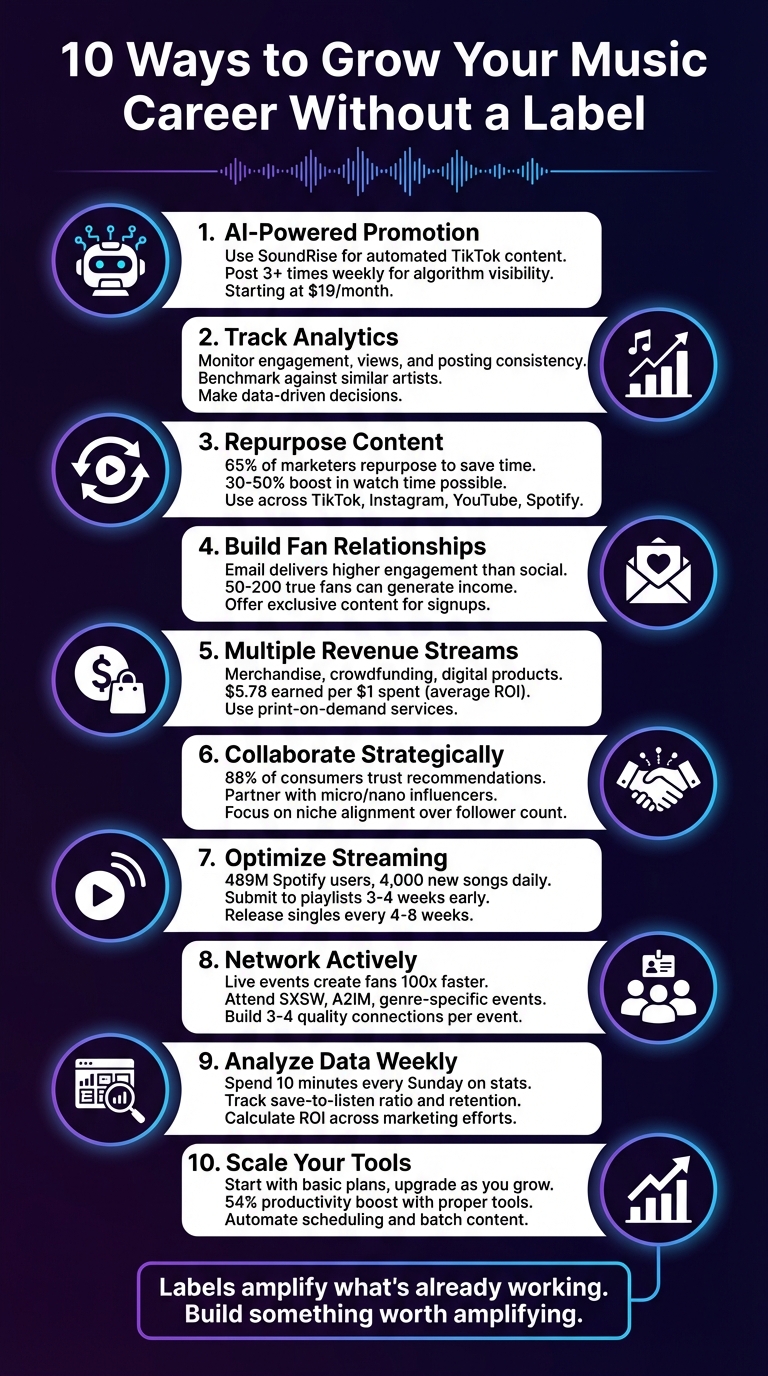
10 Strategies to Grow Your Independent Music Career Without a Label
How Indie Artists Can Grow From $0 to $100,000 Per Year With Music In 2025
1. Use SoundRise for AI-Powered TikTok Promotion
For independent musicians, keeping up with TikTok’s demand for consistent content can feel overwhelming. Between writing music, rehearsing, and managing the business side of things, finding time to shoot, edit, and post daily videos might seem impossible. That’s where SoundRise steps in with its AI-powered automation to make life easier. This tool simplifies video creation, helping you maintain a steady posting schedule without the extra stress.
Here’s how it works: SoundRise generates faceless TikTok videos automatically - no filming required. You just connect your music, and the AI creates beat-synced slideshow videos with visuals tailored to your genre. These videos are designed to grab attention within the first 5 seconds, which is critical for keeping viewers engaged and improving completion rates - a key factor in TikTok’s algorithm.
Consistency is vital for staying visible on TikTok. Posting at least three times a week signals to the platform that you’re an active creator. With SoundRise, you can automate your posting schedule, ensuring each video is between 15 and 30 seconds long - the sweet spot for maximizing viewer retention. This means you can focus on what you do best: making music, while the platform handles the content creation.
SoundRise doesn’t just save you time - it also helps you plan ahead. Its AI tools can generate 30-day content calendars to keep your TikTok strategy on track. Pricing starts at $19/month, which includes 20 video exports, unlimited slideshow drafts, direct TikTok publishing, and access to a full content library. For those with bigger needs, the $49/month Growth plan offers 50 video exports across multiple campaigns.
The best part? This system works for you even when you’re busy performing, rehearsing, or simply taking a break. Faceless videos allow your music to shine while your content runs around the clock. What once required a full marketing team can now be managed directly from your smartphone, turning TikTok promotion into a smooth, efficient process.
2. Track Performance with SoundRise Campaign Analytics
Creating content is just the first step - figuring out what actually resonates is what sets successful artists apart. SoundRise's campaign analytics offer a clear view of how your TikTok videos are performing, helping you make smarter, data-driven decisions for your next content move.
For independent musicians, every detail matters. The dashboard tracks essential metrics like total video engagement (likes, comments, shares, and saves), organic views, and average engagement per video. Instead of obsessing over a single viral hit, focus on spotting trends. For example, if your behind-the-scenes clips regularly outperform your official teasers, that’s a clue to refine your strategy in favor of what your audience loves most.
"Connect video content and make sure to use analytics to keep track of efforts. Create a road map and be willing to make adjustments as you move forward." - Darrell Ellis
SoundRise also tracks posting consistency, showing the total number of videos you've published and your average daily posting rate over the past 30 days. By tagging videos by theme - like "studio sessions" or "song snippets" - you can identify which content themes are driving the most engagement. If raw and personal videos are outperforming polished ones, it might be time to lean into that authenticity.
Another powerful feature is benchmarking against similar artists in your genre. This tool highlights trends in video length and content themes, giving you actionable insights to refine your approach. For instance, tracking average video length alongside engagement rates helps you tailor your content to better connect with your audience. Considering that streaming now accounts for 69% of recorded-music revenue worldwide, understanding how to convert TikTok views into Spotify streams is key to turning your creativity into income.
3. Repurpose SoundRise Videos Across Multiple Platforms
Take one video and make it work across multiple platforms to get the most out of your content. SoundRise automatically creates videos in a 9:16 vertical format, perfect for TikTok, Instagram Reels, YouTube Shorts, and Spotify Canvas. From there, you can slice a 60-second clip into 15-second ads, 8-second Spotify loops, or even full-length YouTube versions. This "Create Once, Publish Everywhere" strategy helps artists stay active and visible without feeling overwhelmed.
Here’s why this approach works: 65% of content marketers repurpose content to save time, and 46% say it’s more effective than starting from scratch. Plus, sticking to a consistent visual style helps build instant brand recognition. A single repurposed clip can act like a gateway - someone might catch your video on YouTube Shorts and end up exploring your full music catalog on Spotify.
"Brands that don't repurpose are always creating. Brands that do repurpose are always scaling." – socialvibe
To make the most of repurposing, you’ll need to tweak each clip for its specific platform. For instance, Instagram Reels users expect polished visuals, while TikTok audiences often prefer a more raw, behind-the-scenes vibe. Don’t forget to clear your music for use across all platforms.
SoundRise's AI-generated visuals can give you an edge, too. Internal tests reveal that videos created with these tools see a 30–50% boost in watch time on Instagram Reels. With over 100,000 new songs uploaded daily, repurposing helps you cut through the noise. Tools like Later or Buffer make it easy to schedule posts across platforms, keeping your presence consistent without adding extra work.
4. Build Direct Fan Relationships Through Email and Social Media
Social media can bring listeners to your doorstep, but email helps you keep them engaged for the long haul. When you grow an email list, you’re in control of the connection. Unlike platforms like Instagram or TikTok, email tends to deliver stronger engagement and higher open rates. It’s also a reliable tool for generating revenue through merch drops, tour tickets, and crowdfunding campaigns. Think of social media as the spark of interest, while email builds the deeper, lasting connection.
"If you don't own the relationship, the algorithm does." – Qoncert
To kick off your email list, offer fans something they’ll value - like an unreleased track, a digital lyric book, or a merch discount code. At live shows, use QR codes to make signups quick and easy. Once someone signs up, send an automated welcome email that delivers their reward and sets expectations for what’s next. Even with as few as 50 to 200 dedicated "true fans" on your list, independent artists can start generating meaningful income.
On social media, focus your energy on one platform that aligns with your style. TikTok works great for sharing raw, unfiltered moments, while Instagram is better suited for a polished, branded look. Engage actively with your followers - reply to their messages, send personal voice notes, and ask for their input on upcoming projects. These small but meaningful interactions help build a stronger connection over time.
Consistency is key for email communication. Aim to send at least one newsletter a month. Use these updates to share personal stories, behind-the-scenes glimpses, or even a “day in the life” snapshot. You can also segment your email list by location to promote city-specific tour dates or by engagement level to reward your most loyal fans with early access to new content. Taking charge of your fan relationships is a crucial step toward building a sustainable career.
5. Create Multiple Revenue Streams with Merchandise and Crowdfunding
Building a direct connection with your fans opens up opportunities to create multiple income streams, which can help you keep more of your earnings. While streaming platforms provide limited income, selling directly to fans flips the script. Physical merchandise - like t-shirts, hoodies, vinyl records, or tote bags - gives fans something tangible to show their support. Meanwhile, digital products such as beat packs, exclusive demos, lyric books, or design templates can be delivered instantly, making them a convenient option. You can even explore offering unique experiences, like early access to new tracks, Discord memberships, or tickets to intimate house shows.
Using print-on-demand services can take the stress out of managing inventory. Platforms like Big Cartel (which has a basic plan starting at $0/month) or Fanbace handle everything from printing to shipping after a sale is made, so you don’t have to worry about unsold stock. Big Cartel alone has supported over 3 million shops worldwide, generating more than $2.5 billion in total sales. If you’re just starting, keep it simple - try one t-shirt design or a single digital product to see what clicks with your audience.
Crowdfunding is another powerful way to engage your most loyal fans and turn them into active supporters. In 2012, Amanda Palmer famously raised over $1.2 million on Kickstarter from nearly 25,000 fans to fund her album Theatre Is Evil, smashing her original $100,000 goal. You don’t need a massive fanbase to make an impact - 50 to 200 dedicated backers can still generate meaningful income. Platforms like Patreon allow you to set up tiered rewards (e.g., $1/month for basic access, $3/month for downloads, $5/month for exclusive perks), while Kickstarter is ideal for one-time projects like funding an album release.
"Streams are cool, but they don't pay the rent. If you want more control and better margins, sell direct."
– Nadav Peleg, Founder & CEO, SoundCampaign
Creating urgency can also boost sales. Try limited drops like “only 50 signed copies available” or “first 10 orders get a handwritten note.” Bundling items - like pairing a vinyl record with a digital EP - can increase the value of each order. Plus, every sale provides something invaluable: direct access to fan emails and locations, which you can use to promote your next release. By diversifying your income through merchandise and crowdfunding, you not only increase your earnings but also deepen your connection with fans, laying the groundwork for future success.
sbb-itb-e87b2af
6. Partner with Niche Artists and Influencers
Teaming up with the right artists and influencers can open doors to new audiences without breaking the bank on ads. The secret? Choosing collaborators who align with your style and attract an audience that complements yours - not just someone with a massive follower count. Niche influencers, especially those focused on specific genres like indie, lo-fi hip-hop, or dark techno, may have smaller followings, but their fans are loyal and trust their recommendations. In fact, 88% of global consumers trust recommendations from people they know (including influencers) more than any other marketing channel. Plus, brands typically earn about $5.78 for every $1 spent on influencer marketing.
To find the right influencers, explore Instagram and TikTok using hashtags tied to your genre. Platforms like Upfluence or AspireIQ can help you zero in on creators with strong engagement rates rather than just high follower counts. Micro-influencers (10,000–100,000 followers) and nano-influencers (1,000–10,000 followers) often deliver the best bang for your buck. Why? High engagement rates often mean their audience is active and genuinely interested in their content. When reaching out, avoid generic pitches. Instead, reference their work and explain how your music aligns with their content. Offer a win-win proposal, like co-creating content or trading promotional posts.
Once you've found potential collaborators, focus on crafting something unique together. For example, you could host a behind-the-scenes studio tour or swap social media accounts for a day, giving each of you a chance to connect authentically with the other's audience. A great example of this approach is The Kid LAROI, who gained significant exposure after opening for Juice WRLD on his Australian tour in 2019 and collaborating on the track "Go".
"Influencer marketing isn't about choosing the most popular creator; it's about choosing the right one."
– Trackier
Keep costs under control by prioritizing nano and micro-influencers. Many are open to working for modest fees or through "art exchanges", like exclusive tracks or free merchandise. User-generated collaborations are surprisingly affordable, typically ranging from $150–$2,000 per campaign, making them a practical option for independent musicians. Be sure to formalize the partnership with a written agreement covering deliverables, deadlines, payment, and usage rights. Most importantly, allow your collaborators creative freedom. Overly scripted or forced content often falls flat and can erode trust. When both parties bring their authentic voices to the project, the results resonate more deeply with audiences and can lead to lasting professional relationships.
7. Improve Your Streaming and Distribution Approach
Streaming your music is just the beginning; making a real impact requires a thoughtful approach to distribution, metadata, and playlist strategies. With platforms like Spotify attracting 489 million monthly users and Apple Music maintaining 88 million listeners, the competition is fierce. Every day, around 4,000 new songs are uploaded to Spotify, so finding ways to stand out is essential.
Start by optimizing your metadata and artist profiles across platforms like Spotify, Apple Music, and Amazon Music. This means filling out detailed bios, uploading high-quality photos, and ensuring your social media links are consistent. Keep your branding uniform by using the same @username across all platforms. Make use of Spotify Canvas - those short looping videos that accompany your tracks - to grab attention and encourage listeners to save your music. Also, double-check that your releases include accurate ISRC codes and high-quality audio files to avoid any hiccups during distribution. A polished and complete profile sets the foundation for a successful release.
Timing is everything. Submit your tracks for Spotify editorial playlist consideration at least 3–4 weeks before the release date using the "Pitch a song" feature in Spotify for Artists. Securing a spot on one of Spotify's 3,000 official editorial playlists could mean at least 25,000 streams per day. While most major labels release music on Fridays, consider launching your tracks on Wednesdays or Thursdays to avoid getting buried in the Friday rush. To keep your audience engaged and trigger discovery algorithms, aim to release new singles every 4–8 weeks.
"In today's attention economy, consistency isn't just a creative rhythm - it's a discovery strategy." – Christopher Wares, Assistant Chair of Music Business/Management, Berklee
Beyond editorial playlists, expand your reach by using music pitching tools to connect with independent curators, blogs, and radio stations. These tools not only help you gain exposure but often provide valuable feedback and can lead to placement on smaller, influential playlists that open doors to larger opportunities over time. Don’t forget to run pre-save campaigns 2–4 weeks before your release. Pre-saves signal strong listener interest, which streaming platforms take into account when prioritizing new music. Combine this streaming strategy with your broader DIY marketing efforts to build a sustainable and independent music career.
8. Connect at Industry Events and Online Communities
When it comes to building a successful music career, personal connections can often achieve what countless social media posts cannot. Live performances, for instance, are known to create fans at a rate far surpassing that of online interactions - 100 times faster, to be exact. By combining face-to-face networking at industry events with active participation in online communities, you can unlock opportunities that no algorithm can replicate.
In-person events are a goldmine for meaningful connections. Major conferences like SXSW in Austin, TX, and A2IM Indie Week in New York, NY, are excellent starting points, offering chances to network with industry leaders and stay updated on current trends [52, 53]. If you're focused on a particular genre, specialized events like the Amsterdam Dance Event (ADE) - the largest electronic music gathering globally, drawing over 500,000 attendees - are invaluable. Virtual events, such as the ASCAP Experience: Home Edition, also provide free access to insights from top industry professionals. Before attending any event, prepare a concise 30-second elevator pitch that highlights who you are, what you do, and your musical style [57, 59]. Instead of trying to meet everyone, aim to build 3–4 meaningful relationships at each event. Quality connections always outweigh quantity.
"Make connections and build relationships for a career, not a year." – Francesca de Valence, Founder, I Heart Songwriting Club
Online communities are another powerful way to network and collaborate. Platforms like Vampr, which boasts over 1 million creatives, have facilitated countless success stories, such as Madrid-based K!NGDOM landing sync placements and French artist MEGAN surpassing 1 million Spotify streams. Reddit communities like r/wearethemusicmakers and r/musicmarketing, along with forums like Songstuff, are also excellent for exchanging ideas and receiving valuable feedback from peers [55, 58]. These digital spaces complement in-person interactions by keeping the conversation going and fostering continuous growth.
Once you've connected with someone - whether at an event or online - make it a point to follow up within two weeks. Mention a specific detail from your conversation to keep the interaction personal and memorable [59, 61]. Networking is not about amassing business cards or LinkedIn connections; it's about cultivating a support system that evolves with you. Offer introductions and advice without expecting anything in return - this kind of reciprocal generosity lays the foundation for lasting professional relationships [57, 60]. When combined with smart social media strategies and AI-driven tools, these networking efforts create a solid framework for advancing your independent music career.
9. Use Data Analysis to Improve Your Campaigns
Set aside 10 minutes every Sunday night to review your stats on platforms like Spotify for Artists, Apple Music for Artists, and your social media accounts. This quick habit helps you plan the week ahead based on what’s actually working, not just what you assume is effective. In today’s competitive streaming landscape, understanding your data can be the difference between steady growth and stagnation. These initial insights will set the stage for deeper analysis as you refine your strategy.
When diving into the numbers, focus on metrics that reflect genuine fan engagement. For instance, your save-to-listen ratio and listener retention rates are far more telling than raw play counts. If a track has a high skip rate, take a closer look at the first 30 seconds - it might be time to tweak your hook or production style for future releases. Keep an eye on your follower count on streaming platforms, as it’s a reliable indicator of loyalty, while monthly listener numbers will naturally fluctuate with new releases and playlist placements. Plus, geographic data can reveal where your biggest fan clusters are, helping you plan tours and target ads more effectively.
"You can work as hard as you can, but without metrics and defined goals, you'll struggle to make progress in your music career." - DIY Musician
Take it a step further by calculating your return on investment (ROI) across different marketing efforts to pinpoint where your dollars are making the most impact. For example, track email click-through rates and social link performance to see how effective your calls-to-action are. If you’re pitching your music to outlets, calculate your success rate by dividing accepted pitches by total pitches - if the rate is low, it might be time to refine your messaging or target different platforms. On social media, pay attention to video watch times, as they reveal exactly when viewers lose interest.
After every release, take stock of what worked. Did certain tactics lead to more ticket sales or follower growth? Use those insights to adjust your strategy immediately. For instance, if behind-the-scenes studio clips consistently outperform live performance videos, shift your content focus accordingly. Keep a running log of your key metrics across all channels - this historical data will serve as a valuable roadmap for making smarter decisions with future releases.
10. Expand Your Reach with SoundRise Growth and Custom Plans
Once you’ve established a rhythm with consistent content, upgrading your SoundRise plan can streamline your promotional efforts. The Starter plan, offering 20 video exports per month, is ideal for testing the waters. But as your audience grows, you’ll need more exports to maintain the recommended 2–3 weekly posts that keep social media algorithms working in your favor. The Growth plan steps things up, giving you 50 video exports per month for $49, making it easier to produce and schedule an entire month’s worth of content across multiple TikTok accounts.
This upgrade transforms your workflow from manual posting to automated scheduling. Instead of spending countless hours posting videos one by one, you can batch-produce 15–20 videos in a single afternoon. Then, let the platform handle the distribution while you focus on creating new music or engaging with your fans. Artists who embrace structured systems like this often see a 54% boost in productivity and a 43% improvement in organization when managing their careers.
"Artists who utilize appropriate technology tools report 54% higher productivity and 43% better organization in their career management activities." – Cristina Arcega-Punzalan, AMW Group
For those managing multiple projects or working with a team, the Custom plan is a game-changer. It offers unlimited exports and tailored features, perfect for artists who’ve outgrown generic solutions. Whether you’re running high-volume campaigns or juggling different genres and artist profiles, this plan has you covered. Even better, unlimited team member access means your entire crew - whether it’s your manager, visual artist, or social media team - can collaborate seamlessly from a single dashboard.
The higher export limits also open the door to strategic content repurposing. For instance, you could take one music video and break it into several short clips optimized for TikTok, Instagram Reels, and YouTube Shorts. These clips can then be scheduled to roll out over the coming weeks. Smart repurposing like this is essential for staying visible and keeping those algorithms on your side.
Conclusion
Achieving independent success means building and managing your own system. The ten strategies outlined here provide a clear path: use SoundRise to automate TikTok promotions and maintain a steady flow of content, analyze campaign performance to see what works, and adapt that content for every platform where your fans are active. But tools alone won't cut it - you need to actively connect with your audience. Building an email list and engaging directly with fans is crucial. As Tef, CEO of Qoncert, wisely states:
"If you don't own the relationship, the algorithm does".
Financial independence thrives on multiple revenue streams. Expand your income by exploring live performances, merchandise, crowdfunding, and direct fan support.
Measure your progress and scale wisely. As your efforts gain traction, ramp up strategically. Release new music every 4–6 weeks to stay visible in streaming algorithms, and post regularly on social media. Use your campaign data to pinpoint where your audience is most active, then focus on those areas for touring or targeted advertising. With consistent growth, you’ll be ready to level up your promotional tools.
Start small with SoundRise's Starter plan to test your strategy, and as your audience grows, upgrade to the Growth or Custom plans. Always keep in mind:
"Labels don't 'make you big.' Labels amplify what's already working".
The key is to build something worth amplifying - and these strategies and tools can help you do just that.
FAQs
How can SoundRise help me grow my audience on TikTok?
SoundRise leverages AI-powered insights to help independent musicians succeed on TikTok's fast-moving platform. It evaluates real-time streaming and engagement data to pinpoint the parts of your songs that resonate most with listeners, suggests the best times to post for your U.S.-based audience, and even crafts catchy captions paired with trending hashtags.
This means you can focus on creating engaging, shareable videos while SoundRise takes care of tracking trends and fine-tuning your strategy. By putting data to work, it helps you grow your TikTok presence and connect with more fans effortlessly.
How can I connect with fans and grow my music career without a record label?
Building meaningful connections with fans is crucial for independent musicians. Start by staying active on social media platforms like Instagram, TikTok, and X. Engage directly by responding to comments, sharing behind-the-scenes moments, and hosting live sessions to interact in real time. These small efforts can create a sense of community and keep your audience invested in your journey.
Consider setting up a personal website where fans can sign up for an email newsletter. Use this to share updates, exclusive content, and details about upcoming events. It's a simple way to maintain a direct line of communication outside of social platforms.
Live performances - whether streamed online or held in person - offer another opportunity to bond with your audience. Short-form videos can also work wonders for showcasing your music and creativity. Even faceless clips can grab attention and highlight your unique style.
Lastly, take advantage of AI tools to dig into fan behavior. These tools can help you tailor your outreach, making it easier to understand your audience and build stronger, more personal connections.
What are some ways independent artists can earn money without a record label?
Independent artists have plenty of ways to create a steady income by branching out into multiple revenue streams. A good starting point is to make the most of streaming income. Get your music on all the big platforms - Spotify, Apple Music, YouTube Music - and use analytics to track which tracks are resonating most with your audience. Promote those hits to keep the momentum going.
Next, focus on building a more personal connection with your fans. You can sell digital downloads, physical merchandise like T-shirts or vinyl, and even offer exclusive content directly through your website or fan membership platforms. Want to add another layer? Offer services like music lessons, creating custom beats, or production work. Not only do these bring in extra cash, but they also highlight your skills and expertise.
Don’t stop there - look into opportunities like sync licensing, where your music can be used in TV shows, films, or commercials. Collaborating with brands or creating sponsored content is another way to expand your reach and income. By mixing and matching these strategies, you can grow your career on your own terms while keeping full control of your creative vision.