
How to pick which part of the song you want on tiktok
How to pick which part of the song you want on tiktok
TikTok videos rely heavily on sound to grab attention, and your song has just three seconds to make an impact. To pick the best part of your song for TikTok:
- Focus on the hook: Choose the most engaging, emotional, or catchy section, like the chorus or a standout lyric.
- Skip slow intros: Start with high-energy moments to stop users from scrolling.
- Leverage trends: Use TikTok's Creative Center or tools like TokChart to identify trending sounds and styles.
- Test different clips: Post multiple versions or automate TikToks that organically boost your songs to see what resonates with your audience.
- Optimize for visibility: Use keywords, hashtags, and strong visuals to make your clip easy to find.
The right audio snippet can boost engagement, increase shares, and even drive your song to streaming charts. Test, analyze, and refine to find the perfect clip for TikTok's fast-paced audience.
TikTok Song Section Engagement Comparison Guide
1. Finding the Most Engaging Part of Your Song
What Makes an Audio Hook Work
An audio hook is a short, catchy musical idea - a riff, phrase, or rhythm - designed to grab attention instantly. On TikTok, the most effective hooks hit four key marks: they bring immediate familiarity, spark an emotional reaction, disrupt the expected musical flow (a technique known as a pattern interrupt), and create a "completion loop" that keeps listeners coming back for more.
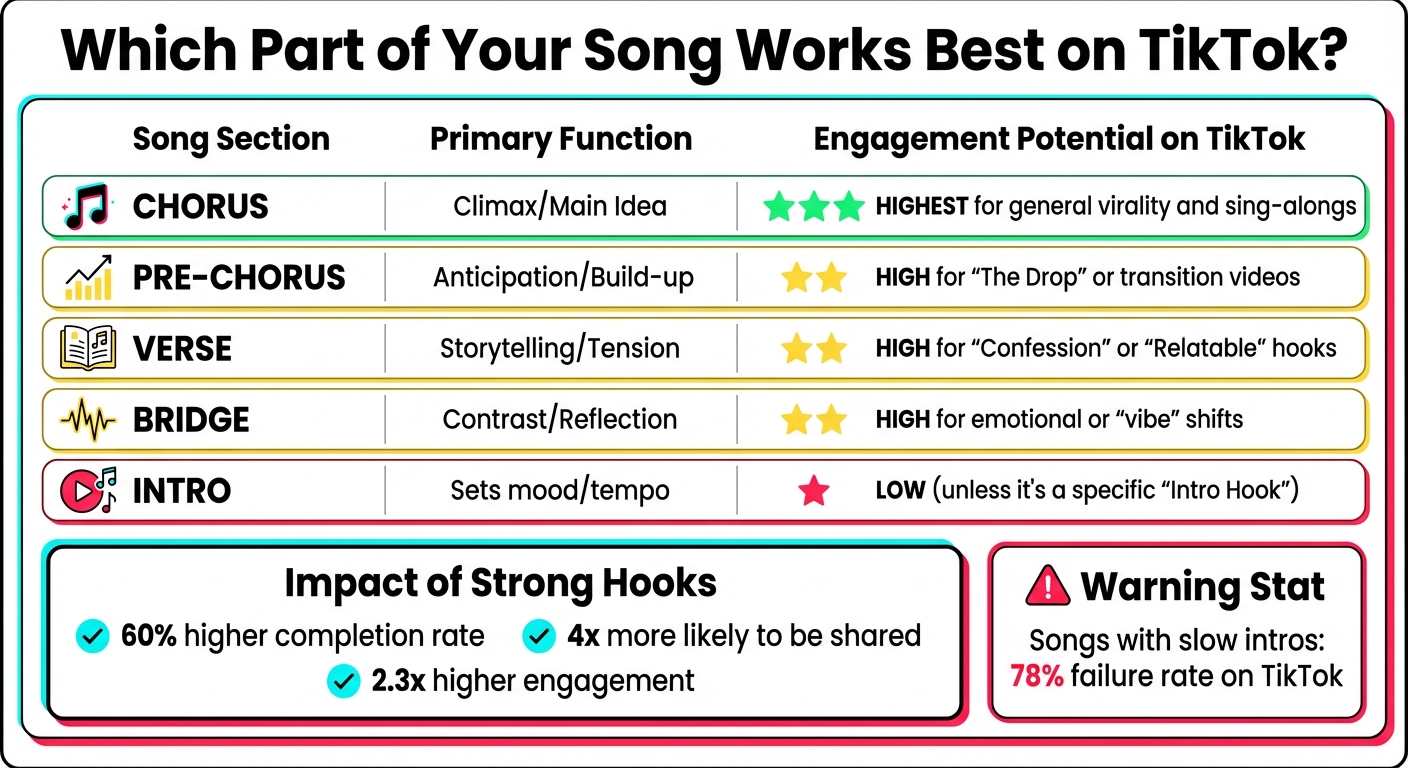
The best hooks deliver an emotional punch right away. Data shows that hooks providing an instant emotional payoff lead to a 60% higher completion rate, are 4 times more likely to be shared, and generate 2.3 times higher engagement. Forget slow builds or gradual intros - TikTok thrives on energy and immediacy. Starting with your song's most powerful moment, whether it’s a standout lyric or the peak of your chorus, is often the way to go.
Songs that open quietly or build too slowly face a 78% failure rate in gaining traction on TikTok. High-energy intros consistently outperform because users make split-second decisions as they scroll. Your hook also needs to be broad and relatable enough for users to create their own content around it, like dance challenges, lip-syncs, or POV videos.
Break Down Your Song Structure
To find the most engaging part of your song, take a closer look at its structure and identify the section that packs the biggest punch.
The chorus is usually the heart of your song. It’s where the main idea shines, paired with the catchiest melody and lyrics. The chorus is all about releasing tension and creating that unforgettable moment listeners want to replay. If your chorus has a standout line or a melodic high point, it’s a great candidate for TikTok’s quick-scroll audience.
The pre-chorus builds anticipation - it’s like the drumroll before the big reveal. This section works especially well for clips that build excitement or transition into a dramatic "drop", which resonates perfectly with TikTok’s fast-paced nature. Meanwhile, the verse is where storytelling happens, making it ideal for "confession hooks" or relatable lyrics that create instant connections. The bridge, on the other hand, provides a shift in tone or emotion, making it perfect for moments that demand a change in pace or mood. Many TikTok-friendly tracks skip traditional intros altogether, jumping straight into the hook to grab attention within the first few seconds.
| Song Section | Primary Function | Engagement Potential on TikTok |
|---|---|---|
| Chorus | Climax/Main Idea | Highest for general virality and sing-alongs |
| Pre-Chorus | Anticipation/Build-up | High for "The Drop" or transition videos |
| Verse | Storytelling/Tension | High for "Confession" or "Relatable" hooks |
| Bridge | Contrast/Reflection | High for emotional or "vibe" shifts |
| Intro | Sets mood/tempo | Low (unless it’s a specific "Intro Hook") |
To maximize engagement, focus on your song’s emotional peak - the moment when the melody hits its highest point or the lyrics perfectly encapsulate your message. Experiment with different hook styles, such as rhythm-based hooks (highlighting beat or chord progressions), instrumental hooks (showcasing riffs or synths), or intro hooks (using a memorable melodic idea right from the start).
2. Using TikTok Trends to Guide Your Selection
Once you've broken down your song's structure, the next step is to tap into TikTok trends to identify which clip will resonate most with the platform's audience.
Study Trending Sounds and Patterns
TikTok's Creative Center is a great tool for spotting trends. You can filter songs by region and timeframe, and even view performance graphs to see if a sound is on the rise, at its peak, or losing momentum. The platform also provides insights into related videos, audience demographics, and has an "Approved for business use" filter - helpful if you're promoting music through an artist or brand account.
Within the app itself, you can search terms like "viral sounds" or "trending music" under the Sounds tab. Keep an eye out for the "Popular" label or tap the spinning record icon on a video to access the sound’s detail page. If you notice recent uploads using the sound, that trend is likely still active. As social media consultant Rachel Karten puts it:
"If you just scroll for like five minutes, you'll hear the same five sounds over and over and you'll sort of understand, 'These must be trending right now'"
Third-party tools like TokChart can also help. They provide daily updates on trending sounds along with regional metrics. TokChart offers monthly plans with options for different account limits and update frequencies. To validate trends, consider cross-referencing TikTok data with Spotify's "Viral 50" playlist, YouTube Trending Music, and the Billboard Hot 100. Interestingly, in 2024, 84% of songs on the Billboard Global 200 chart first gained traction on TikTok.
When analyzing clips that perform well, pay attention to psychological triggers. For example:
- The Question Hook: Opens with a direct question to engage viewers.
- The Confession Hook: Shares a personal revelation.
- The Emotional Peak: Features the song’s most intense or dramatic moment.
Balance Trends with Your Artist Identity
While trends can guide your choices, it's equally important to stay true to your artistic style. Jumping on every trend might dilute your brand, and authenticity is key - especially since nearly 90% of TikTok users emphasize the importance of sound in their experience on the platform. Trends typically consist of four key elements: a message, hashtags, a sonic identity, and a visual narrative. To make a trend your own, keep two of these elements consistent so the trend remains recognizable, and adapt the other two to reflect your unique style.
Focus on Trend Signals rather than fleeting Trend Moments. Trend Signals represent broader shifts, like new storytelling formats or nostalgic remixes, which give you more room for creative interpretation. For instance, sped-up or slowed-down versions of '80s and '90s hits often go viral, offering a framework to showcase your sound while tapping into nostalgia.
Ryan Mitchell, Head of Creator Success at Viryze, advises:
"Study the formula behind viral hooks, then create your own unique version"
Rather than copying a viral video outright, look at its structure. Is it the transitions, the lyrical theme, or the emotional arc that made it work? Apply those insights to your music. TikTok's Creative Center also lets you filter by "Breakout" songs in your region, helping you spot rising trends before they become oversaturated. This strategy allows you to stay ahead of the curve while maintaining your authenticity. Plus, with 96% of artists seeing increased music streams when TikTok videos featuring their songs go viral, the potential payoff is huge.
3. Testing Different Song Clips for Performance
Once you've pinpointed potential hooks and explored current trends, it’s time to dig in and test different sections of your song to see what truly connects with your audience.
Share Multiple Clips with Your Audience
Try A/B testing by posting 2–3 videos that feature different parts of your song. Space them out by 2–3 hours during peak activity times, typically between 6 PM and 10 PM. Pay close attention to how each video performs in the first hour - this is when you’ll get the clearest sense of which part of the song grabs attention.
Don’t stop at just the audio. Experiment with different visuals paired with the same clip. Sometimes, the way a video looks can be just as impactful as the music itself. Dive into the comments section for each test clip. Are people quoting specific lyrics or calling out a particular melody? This kind of feedback can help you identify the moments that spark an emotional response. These insights will guide you in choosing the song segment that aligns best with audience engagement and TikTok trends.
Track Performance with TikTok Analytics
Once your clips are live, TikTok’s analytics tools can help you figure out which one hits the mark. Head to "Creator Tools" in your account settings and select "Analytics" to review your performance metrics. Pay attention to key stats like completion rate, average watch time, saves, and shares. A good benchmark is 10 likes for every 100 views. High save and share rates often signal long-term engagement and viral potential.
Another critical metric is how many users create their own videos using your sound. This kind of user-generated content is a strong indicator of viral momentum.
Check the "Followers" tab to uncover your top-performing regions and the times your audience is most active. This information can help you time your future posts more effectively. If you notice viewers dropping off at a specific point in your video, it might mean your hook needs to come in stronger or sooner. Musicians who consistently apply techniques like the "3-Second Scroll-Stop Method" have reported up to a 300% increase in follower growth within just 30 days.
sbb-itb-e87b2af
4. Making Your Song Clip Easy to Find
Once you’ve picked your standout clip, the next step is making sure people can actually find it on TikTok. To do this, you’ll need to optimize your clip with captions, on-screen text, sounds, and hashtags. TikTok’s algorithm relies on these elements to categorize and push your content to the right audience.
Add Relevant Keywords and Hashtags
Start your caption with keywords that reflect your song’s genre or vibe. This helps TikTok’s algorithm understand and promote your video. For example, if you’re showcasing an indie rock track, lead with something like, "New indie rock anthem for late-night drives," instead of burying the genre further down in your caption.
"Include keywords in the first line, pick sounds that fit the idea, and use two or three niche tags plus a brand tag."
– Sarah Cornley
When it comes to hashtags, aim for a mix. Use one or two broad tags like #NewMusic or #Trending, then add 2–3 niche-specific ones such as #AltMusic or #SynthPop. Don’t forget a unique tag tied to your brand, like your artist name or song title. To stay ahead of trends, check TikTok’s Creative Center and look for hashtags marked as "Breakout" or "New to Top 100." These tags are gaining traction but aren’t yet overused.
If you’re targeting a specific area - like Austin or Nashville - sprinkle in location-based keywords and hashtags. This can help you connect with local fans and music scenes.
Finally, pair your optimized metadata with visuals that grab attention right away.
Pair Audio with Strong Visuals
The first three seconds of your video are crucial. Clips with a strong hook in this window are 60% more likely to keep viewers watching and are shared four times more often. Ditch slow intros and jump straight into the most engaging part of your video to hook viewers immediately.
Use on-screen text to highlight your keywords and give viewers a reason to stick around. Place the text at the top of the screen to avoid it getting covered by TikTok’s interface. Make sure your visuals sync with the rhythm and standout moments of your audio track for maximum impact.
Keep your videos short and punchy - 10 to 20 seconds is ideal. Cut out any pauses, filler, or static shots. Adding quick edits, angle changes, or zoom effects every few seconds keeps the pace lively and prevents viewers from scrolling past. And remember, authenticity often beats flashy production when it comes to connecting with your audience.
Conclusion: Main Points for Selecting Your TikTok Song Clip
To make your TikTok content stand out, focus on mastering the three-second rule. Your chosen clip should grab attention instantly, spark recognition, and encourage interaction. Videos that hit this sweet spot see a 60% higher completion rate and are four times more likely to be shared. These principles lay the groundwork for aligning with trends effectively.
Experiment with different hooks to find what resonates. This trial-and-error process can lead to a 300% growth in followers. Leverage tools like the TikTok Creative Center to identify "Breakout" sounds or tracks labeled "New to Top 100" to stay ahead of trends before they peak.
While trends are key, don't forget to stay genuine. Prioritize sounds with a sharp rise in popularity over those already tied to millions of videos. Dive deeper into what makes these sounds work - consider timing, editing styles, and the punchlines that drive engagement.
Finally, revisit your discovery optimization strategies (discussed earlier in Section 4). Pair your winning audio with compelling visuals and detailed metadata to enhance visibility. The impact is clear: 13 out of the 16 Billboard Hot 100 No. 1 songs in 2024 were propelled by TikTok trends. Your song choice could be the game-changer.
FAQs
How can I choose the best part of my song for TikTok?
To choose the ideal segment of your song for TikTok, zero in on the part that grabs attention right away. This could be a catchy hook, a beat drop, or a standout lyric - something that works well with TikTok's quick, punchy format and current trends.
Pinpoint the most memorable section of your song, whether it’s the chorus, pre-chorus, or even a single, unforgettable line. Aim for a snippet that's 15–30 seconds long, with the most impactful moment hitting early to immediately engage viewers. Test your choice by uploading a private TikTok or sharing it with a few friends to see how it resonates. Make adjustments if needed, then finalize the clip for public posts. Pair it with trending captions or hashtags to boost its visibility.
By tailoring your snippet to TikTok’s fast-paced and trend-driven vibe, you’ll give your track a better shot at gaining traction and possibly going viral.
How can I choose the best part of my song to feature on TikTok?
To find the most engaging part of your song for TikTok, zero in on a short, attention-grabbing segment. This could be the hook, a beat drop, or a lyric that really stands out. Post different clips as separate TikToks, keeping visuals, captions, and hashtags consistent so the only variable is the audio. Then, use TikTok’s analytics to monitor key metrics like watch time, completion rate, and engagement (likes, shares, and comments) within the first 24 hours. These numbers will help you figure out which clip resonates the most.
You can also try AI tools that analyze trending content to suggest which parts of your song might have viral potential. Once you’ve identified a strong contender, take it a step further - tweak the tempo or enhance the hook - and test it again. By blending creative adjustments with data-driven strategies, you can better align your song with TikTok trends and what your audience loves.
How do I choose the best part of a song to feature on TikTok?
To make your TikTok video pop, focus on using the most attention-grabbing part of your song - this could be the chorus, a catchy hook, or a standout lyric. Kick off your video with this segment to instantly draw viewers in and keep them watching.
Keep it snappy, aiming for a length of 15–30 seconds, and ensure the audio quality is sharp. Pair the song with eye-catching visuals, like quick edits or transitions synced to the beat, to match TikTok's fast-paced vibe. Adding hashtags and captions that tie into trending challenges or themes can also help your video gain traction.
Try different starting points and visual styles to figure out what clicks with your audience. Once you hit the sweet spot, fine-tune the combination to maximize engagement. A well-chosen song clip paired with dynamic visuals can make your video more shareable - and boost its chances of going viral.