
Best Practices for Faceless TikTok Music Promotion
Best Practices for Faceless TikTok Music Promotion
Faceless TikTok videos let your music shine by focusing on sound rather than visuals. They use text, animations, or stock footage instead of showing faces, making them easier and faster to produce. TikTok's algorithm prioritizes engagement over follower count, so even unknown artists can go viral with the right content. Here’s how to make faceless videos work for you:
- Choose the Right Snippet: Use a catchy 15–30-second part of your song that grabs attention in the first 2.7 seconds. Avoid slow intros.
- Follow Trends: Use TikTok's Creative Center to spot rising sounds and align your music with them.
- Use Effective Visuals: Match your visuals to your genre and change them every 3–5 seconds to keep viewers engaged.
- Optimize for the Algorithm: Aim for high completion rates (above 50%) and short, engaging videos of 15–30 seconds.
- Automate Posting: Use tools like SoundRise to schedule 3–5 posts per week and maintain consistency.
- Track Performance: Monitor metrics like watch time, completion rate, and shares to refine your approach.
Consistency and data-driven decisions are key to growing your audience and boosting your music’s reach on TikTok.
How FACELESS Artist Got Nearly 1 MILLION Music Streams
Choosing the Right Music Snippets for Engagement
When promoting music on TikTok without showing your face, picking the perfect snippet is everything. A well-chosen 15–30-second segment can be the difference between a few hundred views and hundreds of thousands. TikTok users decide to keep watching or scroll away in just 2.7 seconds, so your snippet has to grab attention instantly. Forget traditional song structures like slow intros or drawn-out verses. Instead, jump straight to the good stuff - think a powerful chorus, an emotional peak, or a catchy lyric.
"The harsh truth? You have exactly 2.7 seconds to stop someone from scrolling."
Snippets designed for user-generated content (UGC) tend to perform much better, with an 82% higher usage rate compared to traditional tracks. The secret? Opt for sections that encourage creativity, like remixes, duets, or challenges. For instance, DJ Kato’s lyric "Spin when the beat drops" inspired 3.8 million user videos because it gave people a clear action to follow.
Analyzing TikTok's Viral Music Trends
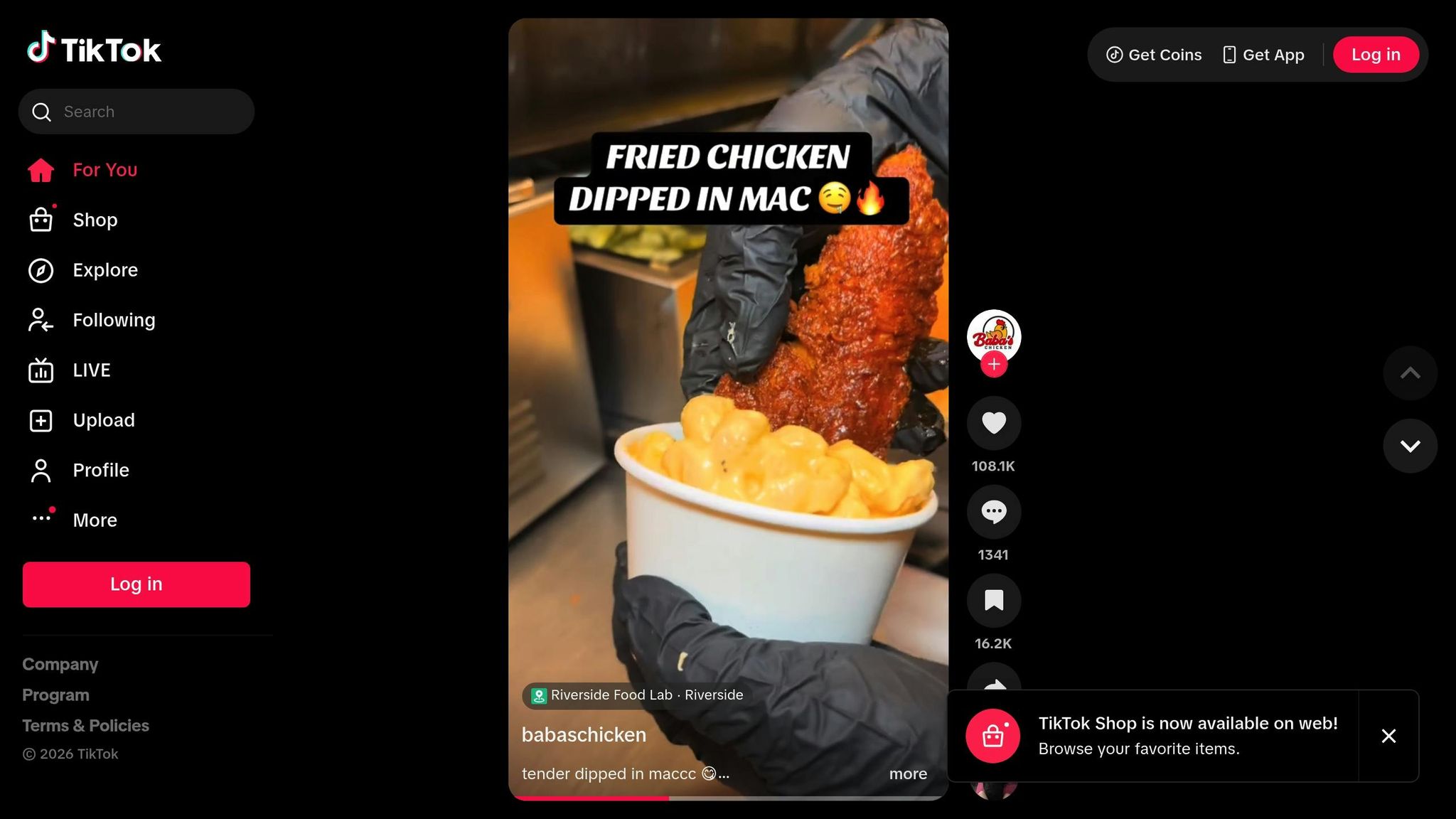
Before locking in your snippet, take a deep dive into TikTok's trending sounds. The TikTok Creative Center is a goldmine for this, offering filters like "Breakout" and "New to Top 100" to spotlight tracks gaining momentum. Narrowing the time frame to the "Last 7 days" can help you catch trends before they peak.
Another useful tool is the "Related Videos" section, which reveals how successful TikTokers time their videos - like when beat drops hit, how text overlays are placed, and which camera angles get the most views. Cedric Yarish, Co-Founder of AdManage.ai, explains:
"Finding trending sounds isn't about discovering what's already viral (too late). It's about spotting the curve while it's rising, jumping in before saturation, and doing it in a way that's actually usable for your content type."
To keep things organized, consider using a scoring system to evaluate snippets. Rank them based on factors like rising interest, repeatable formats, audience fit, and commercial potential. You can also create a "Favorites Library" by saving sounds that pop up repeatedly during your browsing - this often signals a growing trend.
Once you've identified trending sounds, the next step is zeroing in on the specific sections that will drive the most engagement.
Identifying High-Impact Song Sections
To pick snippets that grab attention and go viral, you can follow the V.I.R.A.L. Framework:
- Velocity – Hook viewers within the first 3 seconds
- Identity – Include a standout sonic element
- Relevance – Align with current TikTok trends
- Accessibility – Make it easy for others to use
- Loopability – Ensure the snippet plays smoothly on repeat
Songs that check all five boxes are 12 times more likely to go viral.
| Hook Type | Purpose | Example Strategy |
|---|---|---|
| Emotional Punch | Immediate impact | Start with the chorus drop |
| Pattern Interrupt | Disrupt scrolling | Use an unexpected sound or reverse vocals |
| Instant Relate | Resonate with viewers | Include relatable lyrics |
| Sonic Signature | Create recognizability | Add a whistle, hum, or vocal tag |
| Challenge Catalyst | Spur participation | Include a clear call-to-action |
Test potential snippets by creating 3–5 second preview videos and tracking their completion rates. The snippet with the highest retention becomes your go-to asset. For example, Sofia Mills hit 4.2 million views in just 48 hours by starting with a chorus drop, while ZAYBO racked up 8.7 million views with a 92% completion rate by using reverse vocals that made people replay the video.
Don't forget to include elements like smooth transitions, quotable lyrics, and shifts in energy. Emma Rose used a unique whistle-hum combo that sparked over 50,000 duets and reached 12 million viewers through recreated content.
These strategies not only make your snippets engaging but also streamline the process of creating TikTok content at scale.
Creating Genre-Specific Faceless Videos
Once you've chosen the ideal snippet, the next step is to design visuals that align with your genre's mood. You don’t need expensive gear or a full production crew. AI tools and smart visual sourcing can help you create polished videos that connect with your audience - all without showing a single face.
The trick lies in matching your visuals to the emotional tone of your music. For instance, dark and moody visuals suit electronic tracks, while vibrant nature scenes fit uplifting pop songs. To keep viewers engaged, aim to change visuals every 3–5 seconds. This approach, known as "pattern interrupts", achieves 58% retention compared to 41% for static videos. And since 85% of TikTok users watch videos without sound, your visuals need to tell a story on their own. Once your visuals match your music, you can fine-tune production details to maximize engagement.
Don’t forget the technical side. Always shoot in a 9:16 vertical aspect ratio - it can boost impressions by 60.5%. Using a resolution of 720p or higher adds another 5.4% boost.
Using AI Tools for Slideshow Videos
AI tools have made it much easier to create genre-specific content quickly. Instead of spending hours on edits, you can produce slideshow videos in minutes. Platforms like SoundRise let you create unlimited slideshow drafts tailored to your music's vibe and export them as ready-to-post TikTok videos. The AI takes care of syncing visuals to your track’s rhythm.
These slideshows essentially consist of high-quality images transitioning in time with your music. For storytelling genres like hip-hop or country, you can use images that build a narrative. For electronic or ambient tracks, abstract AI-generated visuals can create a mesmerizing loop.
Darren Suffolk, Creative Director of Video Services at Superside, explains it well:
"AI isn't a trend anymore, it isn't going back in the box. We need to start thinking about AI like any other tool. What new possibilities does it offer to us?"
For music promotion, AI delivers speed and scalability. You can test different visual styles across multiple tracks without straining your budget.
Finding Genre-Appropriate Images
Finding the right images is where your understanding of your genre becomes invaluable. Pinterest is a fantastic resource for music marketers. Search for terms like "dark urban photography" for drill music, "vintage concert posters" for indie rock, or "neon cyberpunk" for electronic tracks.
SoundRise integrates with Pinterest, allowing you to pull images directly into your slideshow drafts. This integration simplifies the process from brainstorming to the final product. Free stock libraries like Pexels, Pixabay, and Storyblocks are also great for sourcing high-quality visuals that match your music's theme.
Consistency is key to building a recognizable visual identity. Stick to specific filters, color schemes, or image styles to create a cohesive visual "universe" for your artist's account. For example, if you’re promoting lo-fi beats, using warm, cozy interior shots consistently can help fans associate those visuals with your sound. This approach not only strengthens your branding but also helps TikTok’s algorithm identify and target the right audience for your content.
Optimizing Videos for TikTok's Algorithm
To make the most of faceless TikTok videos, you need to align your content with TikTok's algorithm. The platform's recommendation system places a heavy emphasis on two key metrics: completion rate (how many viewers watch your video all the way through) and watch time. These factors are critical for getting your videos noticed. TikTok specifically rewards videos that grab attention in the first 2.7 seconds.
Another important metric is reaction density, which measures how quickly and intensely viewers engage with your content. Interestingly, TikTok doesn't prioritize follower count when promoting videos. Even accounts with zero followers can go viral if the initial audience finds the content engaging.
"The TikTok algorithm rewards content that is watched all the way through, so aiming for a snappy 15-30 seconds is a good place to start".
For music-related content, videos between 21 and 34 seconds tend to perform best for business purposes. Videos with a completion rate above 50% do well, while rates over 70% are exceptional. This makes precise editing crucial to ensure every second of your video keeps viewers hooked.
Editing for Short Attention Spans
Fast-paced editing isn't just a creative choice - it’s a necessity. To keep viewers engaged, switch visuals every 2–3 seconds. This quick pacing keeps your content dynamic and prevents viewers from losing interest.
Start strong by hooking your audience in the first three seconds. Use bold visuals, an intriguing statement, or a teaser that sparks curiosity - something that leaves viewers wanting to see how it ends. For music videos, lead with the most energetic part of your track, like a catchy drop or a standout vocal line. A slow build simply doesn’t hold up against TikTok's fast-moving feed.
"The algorithm rewards rapid, strong reactions".
Keep your videos between 15–30 seconds to encourage completion and replays. These factors are crucial for TikTok's algorithm. While longer videos (over 60 seconds) can sometimes reach a broader audience - up to 43.2% more reach - shorter videos are more likely to be finished and replayed.
Adding Captions and Text Overlays
Text overlays are a powerful tool to enhance both accessibility and discoverability. They make your content more inclusive, especially for the 30% of TikTok users who watch videos without sound, and they help the algorithm understand and categorize your content.
TikTok uses on-screen text and captions as part of its search ranking process. This is where TikTok SEO comes into play. For example, if you're promoting a lo-fi hip-hop track, include phrases like "chill beats for studying" or "late night vibes" in your text overlays. Place these key phrases prominently in your captions and on-screen text within the first three seconds. With TikTok's expanded 2,200-character caption limit, you have plenty of room to optimize for search.
Text overlays also help retain viewers. Creative text elements that require reading can increase overall watch time and improve brand recall. Studies show that 90% of ad recall happens within the first six seconds, and 63% of successful videos highlight their main message in the first three seconds. Use text to tease your hook without revealing too much upfront.
"Text on the screen is the best way to [set up a reveal] but don't give away the game".
For best results, use TikTok's native text editor or CapCut for your overlays. Content created within TikTok's ecosystem tends to perform better. When competing for organic reach, every small detail matters.
sbb-itb-e87b2af
Automating Content Creation and Posting
Manually posting content on TikTok can become a significant hurdle for artists and labels trying to keep up with the platform's fast-paced demands. TikTok’s algorithm thrives on consistency - accounts posting at least five days a week experience a 34% higher median view growth compared to those posting sporadically. One way to avoid burnout is through batch-creation, which helps balance the demands of daily posting with other career priorities.
"The pressure to create regular, high-quality content can be overwhelming, especially for musicians juggling other responsibilities like recording, performing, or managing their careers. For some, this constant demand can lead to burnout."
– Scott McCormick, Musician and Author
Just as faceless videos simplify production, automation simplifies the posting process. By shifting from daily uploads to strategic planning, artists can batch-create content and use scheduling tools to maintain a steady flow of posts. This consistency aligns with TikTok’s preferences, helping creators stay visible. In fact, 84% of songs that entered the Billboard Global 200 in 2024 gained traction on TikTok first, proving that consistent posting can directly influence commercial success.
Setting Up Consistent Posting Schedules
Regular posting trains TikTok’s algorithm to associate your artist's content with a specific sound and niche. Posting consistently - ideally 3 to 5 times per week - keeps your content circulating without overwhelming your audience. To simplify this, allocate a few hours to produce 15–20 clips in one session, then schedule them across multiple weeks.
Timing is just as important as frequency. TikTok’s analytics can show you when your audience is most active. Posting during these peak times can maximize early engagement - likes, comments, and shares within the first hour - which signals the algorithm to push your content to a broader audience. Automation tools ensure you hit these optimal windows even when you're busy recording or performing.
Using SoundRise for Automated Publishing
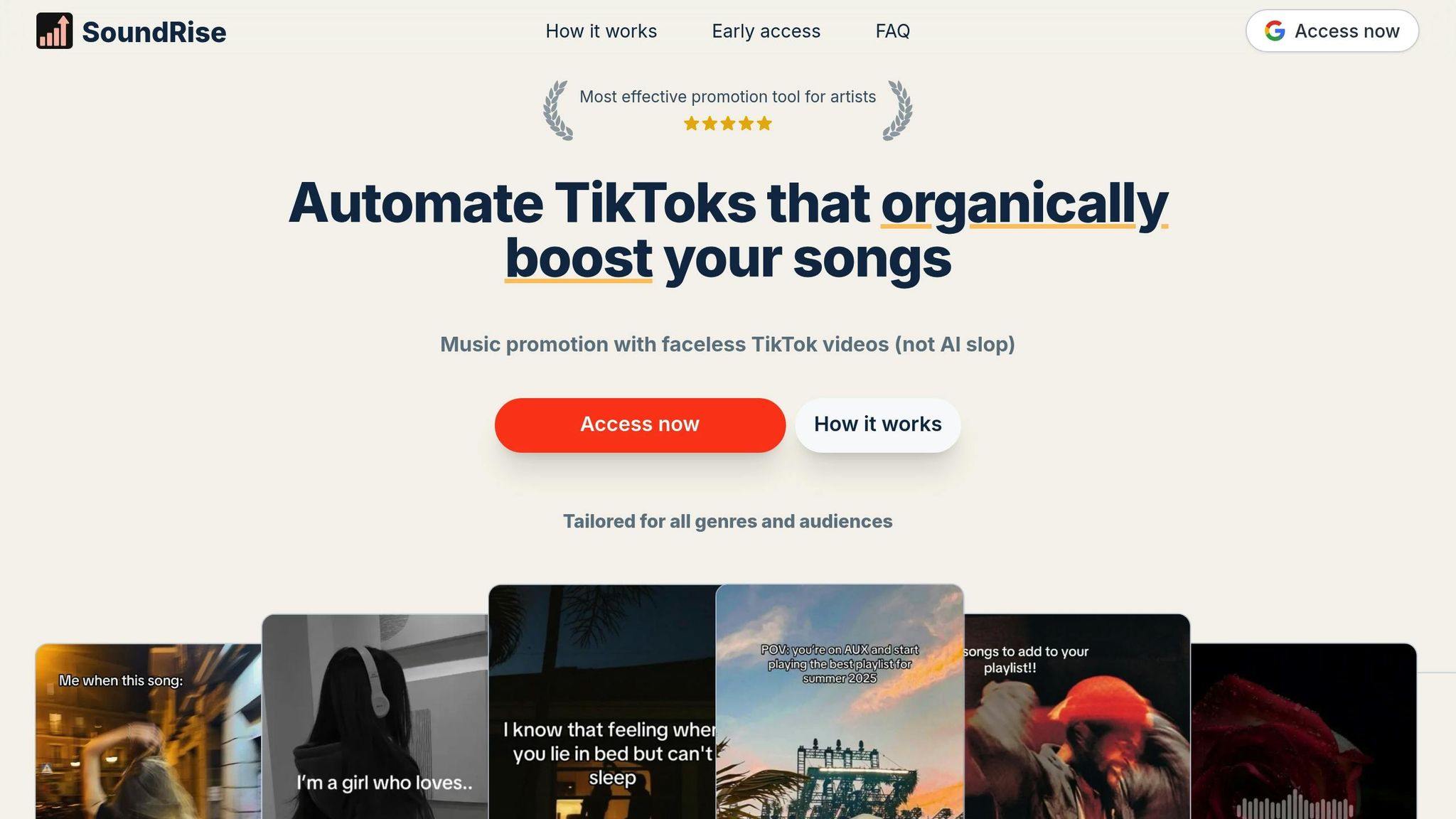
Once your posting schedule is ready, automation tools can take over the execution. SoundRise is a tool designed for automated TikTok publishing. By connecting your TikTok Creator account (not Business, to maintain access to the full music library), you can upload videos, schedule posts, and let the platform handle the rest. The Growth plan, priced at $49/month, includes features like direct TikTok publishing and video scheduling with up to 50 video exports per month - perfect for maintaining a consistent 3–5 posts per week.
SoundRise also offers tools to streamline content creation. You can create genre-specific slideshows using its integrated content library, add captions optimized for TikTok SEO, and schedule videos weeks in advance. This "set it and forget it" system lets you focus on high-level strategies, like testing which 15-second hooks perform best in driving engagement and completion rates.
For labels managing multiple artists, SoundRise offers even more flexibility. With unlimited TikTok account connections and team member access, one person can manage campaigns for an entire roster. Automation handles the repetitive tasks, freeing up time for creative decision-making and overall campaign strategy.
Measuring Performance and Improving Campaigns
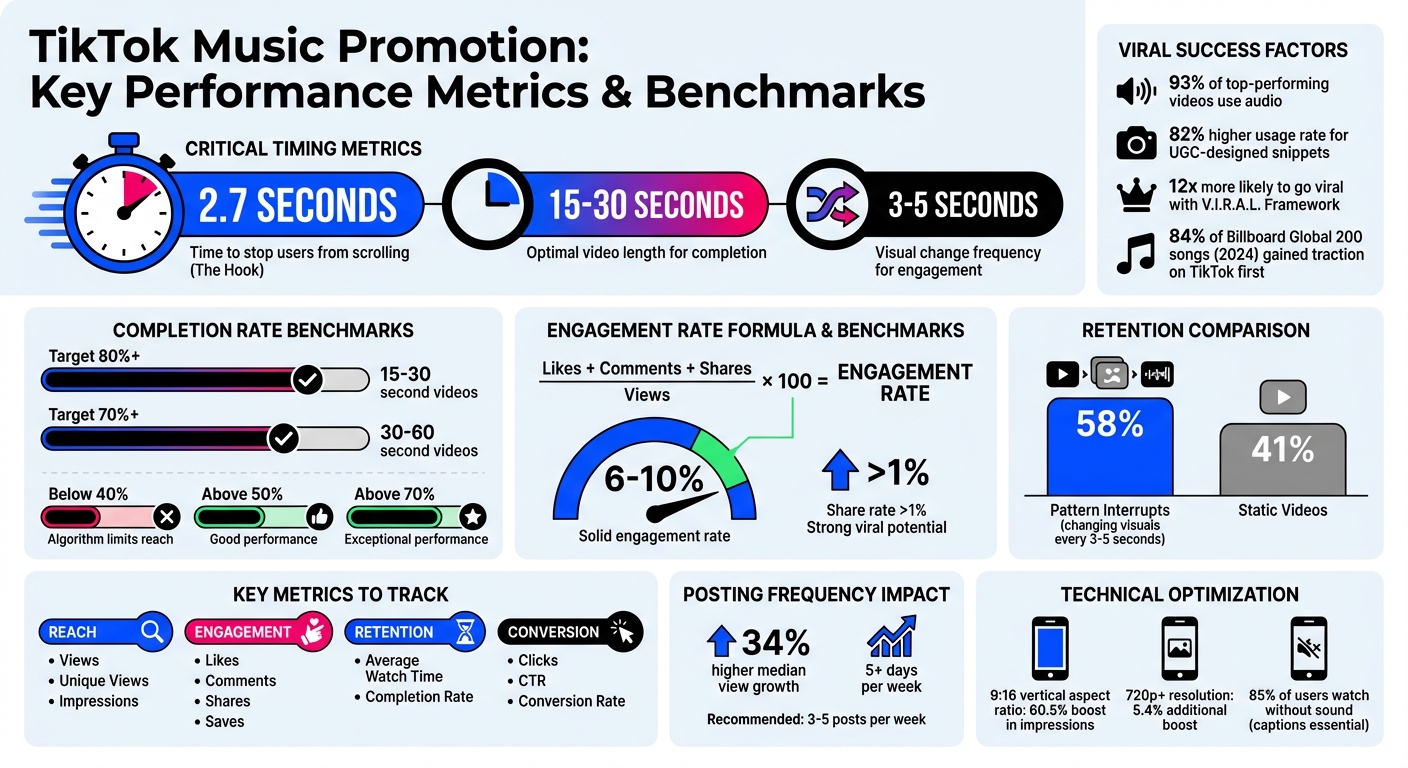
TikTok Music Promotion Key Metrics and Performance Benchmarks
Posting consistently is just part of the equation; the real magic lies in tracking performance to fine-tune your content. TikTok's algorithm prioritizes videos that keep viewers engaged, so understanding key metrics is essential for boosting your reach. TikTok's built-in analytics can tell you where viewers lose interest, which videos are getting shared, and whether your content is hitting the "For You" page or staying within your follower base.
One of the most critical metrics? Watch time. It's the top-ranking factor. For a 30-second video, you need viewers to stick around for most of its duration. The retention graph is your best friend here - it shows exactly where people drop off. If you notice a sharp decline within the first three seconds, it's time to rethink your opening hook. For faceless videos, experiment with different strategies like starting with a catchy chorus, a beat drop, or an attention-grabbing melody to draw viewers in.
Engagement rate is another key indicator of success. Calculate it with this formula: (Likes + Comments + Shares) / Views × 100. A rate between 6% and 10% is considered solid for most accounts. Shares, in particular, are a strong signal of virality. If your share rate exceeds 1%, your content is showing serious potential.
This data-driven approach connects content creation with strategy, helping you optimize your campaigns effectively.
Key Metrics to Track on TikTok
Beyond just views, focus on metrics that show how your faceless videos perform at each stage of the viewer journey. Completion rate is especially important. For videos between 15 and 30 seconds, aim for a completion rate of 80% or higher. Longer videos, in the 30- to 60-second range, should target at least 70%. If your completion rate drops below 40%, the algorithm is likely to limit your video's reach.
Metrics like saves and shares reflect long-term value. When users save your video, it signals that your content - whether it's a music snippet or a visually striking clip - has staying power. For example, in 2025, the agency Nonsensical partnered with Urban Tandoor, a restaurant. Their initial food-focused videos didn’t gain much traction, so they pivoted to staff-led song parodies. Their first big hit, an East 17 spoof, racked up 330,000 views. This data-informed shift eventually led to hundreds of millions of views across their channels.
| Metric Category | Key Metrics | Purpose |
|---|---|---|
| Reach | Views, Unique Views, Impressions | Tracks how many people see your content and its audience scope |
| Engagement | Likes, Comments, Shares, Saves | Shows how actively users interact with your videos |
| Retention | Average Watch Time, Completion Rate | Indicates how well your content keeps viewers watching |
| Conversion | Clicks, CTR, Conversion Rate | Measures how effectively your content drives actions outside TikTok |
Another crucial insight is traffic sources. Check whether your views are coming from the "For You" page or the "Following" feed. A high percentage of FYP views means your content is resonating with a broader audience, not just your followers. For faceless music promotion, this can reveal whether your visuals and song snippets are striking a chord with people outside your usual audience.
By keeping an eye on these metrics, you can make smarter decisions and improve your faceless video campaigns over time.
A/B Testing Video Snippets
Testing different video elements is a powerful way to uncover what engages your audience most. A/B testing works best when you isolate one variable at a time. For instance, you could compare a 15-second chorus clip to a 15-second verse clip while keeping other factors like captions, hashtags, and visuals the same. This method helps pinpoint the specific elements that resonate with your viewers.
For reliable results, run your tests for at least seven days, though two to three weeks is ideal. Avoid making changes mid-test, as this can reset TikTok's learning phase. Once you identify a winning format - say, a high-energy chorus outperforms a slower verse - focus on replicating that success in future videos.
Use the retention graph to fine-tune your content further. If you see a sharp drop within the first five seconds, your hook isn’t strong enough. If viewers lose interest halfway through, it might be a pacing issue. Since 93% of top-performing TikTok videos incorporate audio, testing different parts of a song can help you find the section with the most viral potential. Once you've identified a winning snippet, gradually scale your efforts by increasing promotion budgets by up to 50%, waiting at least two days before making additional adjustments.
Conclusion
To grow an audience that connects with your music, focus on impactful snippets, genre-appropriate visuals, and data-driven strategies. TikTok's algorithm levels the playing field by prioritizing engagement over follower count, giving independent artists the same chance at virality as those signed to major labels.
Getting the technical setup right is crucial for maximizing reach. With 93% of top-performing TikTok videos using audio, your music snippet already carries significant weight. The challenge is staying consistent - posting three to five times a week keeps you relevant without overwhelming your creative energy. By following this guide's approach - from choosing the right snippets to using AI tools - you can ensure all parts of your strategy work together seamlessly.
Streamlining content creation and scheduling is another game-changer. Tools like SoundRise simplify video production and posting, helping you maintain a steady presence while focusing on the creative decisions that truly matter. Once your process is automated, tracking performance becomes essential for fine-tuning your approach.
Pay attention to what works and build on it. Use TikTok's analytics to monitor metrics like completion rates, watch time, and traffic sources. Experiment with different song sections, captions, and visuals through A/B testing to discover what resonates most. When you find a winning formula, scale it thoughtfully. As musician and author Scott McCormick explains:
"Success on TikTok often comes down to a mix of timing, engagement, and understanding what makes content take off".
This approach allows for faceless promotion, where the focus remains on quality music and a smart strategy rather than personal branding. Whether you're an independent artist or managing a roster of performers, these practices establish a repeatable system to connect with listeners who care about the music itself.
FAQs
How do I pick the best music snippet for TikTok videos?
To pick the best music snippet for TikTok, zero in on parts of the song that grab attention immediately - ideally within the first 1.5 to 3 seconds. Choose sections that are instantly catchy and align with what’s trending on the platform. A strong hook, like a memorable beat drop or a standout lyric, can make your video more engaging and shareable.
It’s also smart to pick snippets that work even without sound, as many TikTok users watch videos muted. Think about how the music pairs with visuals or text overlays. Keep it short, impactful, and relevant to viral challenges or trends. Picking the right part of a track can make all the difference in boosting your content’s reach and appeal.
What types of visuals work best for faceless TikTok videos?
For TikTok videos where you’d rather stay behind the scenes, focus on grabbing attention with visuals. Try using dynamic animations, stock footage, or slideshow-style clips to keep things lively. Play around with unique camera angles, fast-paced edits, and bold text overlays to make your content stand out.
Stick to consistent visual themes - like a specific color scheme or font style - to create a recognizable look for your videos. Combine these visuals with trending sounds and short, relatable messages that resonate with your audience. By matching the visuals to the mood of your music, you can successfully promote your tracks without needing to appear on camera.
How does TikTok's algorithm influence music promotion success?
TikTok's algorithm is a game-changer for music promotion, as it decides which videos make it to users' For You Pages (FYPs). The algorithm evaluates factors like user interactions (likes, comments, shares), video completion rates, and how well the content aligns with current trends and individual user preferences.
For artists and labels, this means crafting content that grabs attention, sparks engagement, and keeps viewers hooked until the very end. Strategies like using trending sounds, joining viral challenges, and adding popular hashtags can significantly boost visibility. By aligning content with TikTok's algorithm, musicians can connect with new audiences and grow their reach organically.